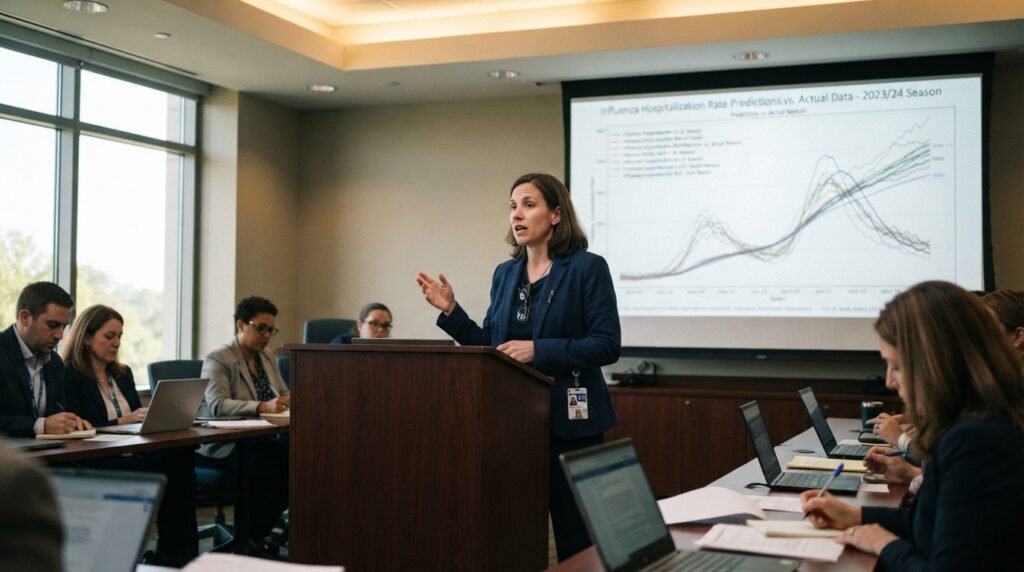
In a recent evaluation conducted by the U.S. Centers for Disease Control and Prevention (CDC), Google’s scientific AI model was identified as the most accurate tool for predicting flu-related hospital admission rates. On September 30, 2026, Google officially announced that its model outperformed 39 other entries in the CDC’s ‘FluSight’ forecasting challenge. This achievement is drawing global attention, as it signals a potential breakthrough in preventing healthcare system overload ahead of the winter flu season and introduces innovations into individual daily health management.
Google’s Scientific AI Demonstrates Superior Predictive Power in CDC Evaluation
Each year, from October to May, the CDC operates the ‘FluSight’ project, which collects and analyzes weekly flu forecast data submitted by government, academic, and industry research teams. The project aims to predict flu-related hospitalizations across the U.S. for the current week and the following three weeks, helping state governments and medical institutions proactively allocate necessary healthcare resources.
For the 2025-2026 season, the AI model developed by Google researchers achieved first place overall, providing predictions most consistent with actual observed flu hospitalization numbers. By outperforming numerous models from university laboratories and government-affiliated institutions, this result proves that the practical utility of AI in disease forecasting has reached a high level of maturity.
How the ‘ERA’ Algorithm is Transforming Medical Fields and National Health Systems
Google’s influenza forecasting model was developed using the company’s ‘Empirical Research Assistance (ERA)’ AI tool. ERA is an innovative AI system that autonomously generates optimization algorithms across various scientific fields, with recent research published in the renowned scientific journal ‘Nature’.
The core technology of ERA lies in its ability to process vast amounts of health data alongside complex variables like climate and population movement in real-time, detecting subtle patterns that human researchers might overlook. Google has begun providing this ERA technology to trusted testers as part of an experimental scientific toolkit and intends to expand its use to predicting various other infectious diseases in the future.
The Real-World Impact of Flu Forecasting on Wallets and Daily Life
Accurate flu forecasting extends beyond scientific achievement, directly impacting household economics and daily routines. The recurring winter flu epidemic often leads to overwhelmed emergency rooms, bed shortages, and rising medical costs. If AI can predict local flu hospitalization rates three weeks in advance, hospitals can more efficiently manage nursing staff deployments and essential medicine stocks (treatments and vaccines).
This efficiency reduces unnecessary waste of medical resources, ultimately leading to greater stability in health insurance finances and lower out-of-pocket costs for patients. Furthermore, for working professionals and dual-income households, knowing the timing of local outbreaks in advance allows for better coordination of vaccination schedules and enhanced personal hygiene, preventing productivity losses and caregiving expenses caused by influenza infections.
Synergy with Wearables: The Era of Personalized Prevention
Public health predictive technology is poised to reach its maximum synergy when combined with wearable devices and mobile healthcare ecosystems. On September 24, 2026, Google announced the launch of ‘Health Guardian’, a new health and safety tool for the Google Health app. This technology continuously monitors user vitals such as blood pressure trends, insulin resistance indicators, and sleep respiration quality via wearables like the Pixel Watch.
By integrating public flu forecasting data with an individual’s real-time biometric data, the near future could allow for hyper-personalized alerts, such as: “The flu is currently spreading in your area, and your immune indicators are low; please take precautions when going out.” This represents a shift in the paradigm of modern medicine from reactive treatment to proactive prevention.
Remaining Challenges and Technical Uncertainties
Despite this promising outlook, significant challenges and uncertainties remain. First, it is unclear whether the AI model’s accuracy will remain consistent in the face of sudden variables like climate change or the emergence of new viral strains. Second, there are concerns regarding potential privacy breaches during the collection and utilization of medical data. New features in the Google Health app are subject to regional regulations, with naming and functionality varying in markets like Japan or Mexico to comply with local laws. Establishing public trust in big tech’s handling of sensitive health information is essential.
Finally, considerable institutional adjustments and time will be required to seamlessly integrate advanced AI forecasting models into real-world clinical decision-making systems. If regulations fail to keep pace with technological progress, even the most exceptional predictive models risk being rendered ineffective in actual public health responses.
Official Sources
- Google Official Blog – Google Science AI Ranks #1 in Flu Forecasting (September 30, 2026): https://blog.google/innovation-and-ai/models-and-research/google-research/google-science-ai-flu-forecasts/
- Google Official Blog – Google Health App New Features Launch (September 24, 2026): https://blog.google/products-and-platforms/products/google-health/health-guardian-features-live/