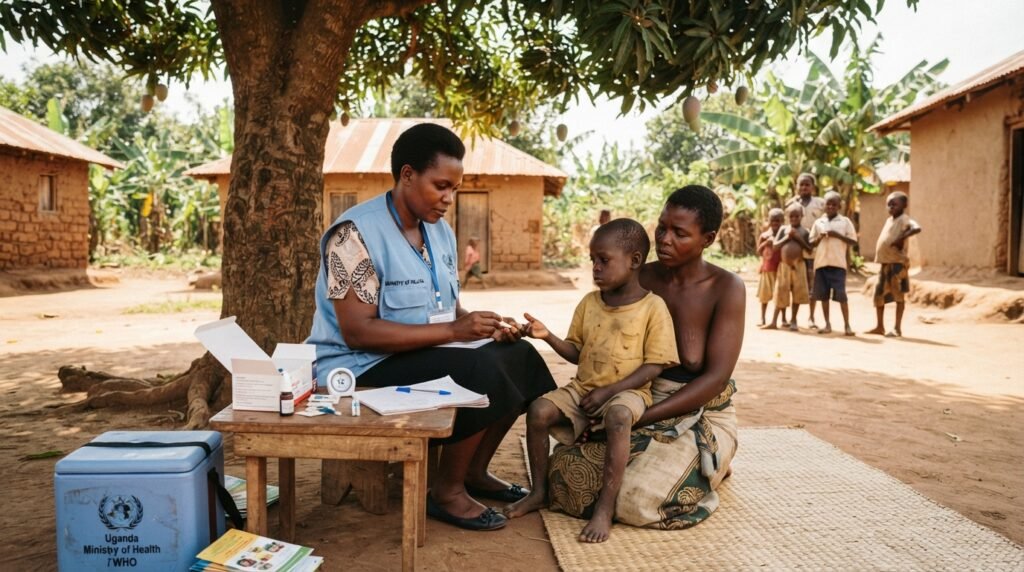
On October 23, 2026, the Ugandan Ministry of Health and the World Health Organization (WHO) Regional Office for Africa officially announced the expansion of malaria diagnosis and treatment services to all age groups, leveraging the nation’s network of community health workers. This strategic shift is designed to revamp the public health system, ensuring that residents in remote areas with limited access to hospitals can receive rapid diagnostic testing and immediate free treatment within 24 hours of symptom onset, thereby significantly reducing the risk of mortality.
85,000 Community Health Workers Mobilized: Expanding Beyond Children Under Five
According to the National Malaria Control Division under the Ugandan Ministry of Health and the WHO, existing community-based malaria response systems were primarily focused on infants and children under the age of five. Consequently, adults or children over five exhibiting malaria-like symptoms faced lengthy journeys to reach distant, higher-level health facilities for accurate diagnosis and care.
Through this expansion, the Ugandan government has committed to training approximately 85,000 Village Health Teams (VHTs) and Community Health Extension Workers (CHEWs) across the country, providing them with direct access to malaria rapid diagnostic tests (RDTs) and free medication. This allows households in remote areas—regardless of age—to receive immediate testing and medication through village health workers at home or nearby community hubs.
Malaria Statistics in Uganda and the ’24-2 Hours Initiative’ Mechanism
While Uganda has successfully reduced malaria-related mortality by over 50% since 2000, the disease remains a critical threat to national public health. Key statistics provided by Ugandan health authorities include:
- 2025 Malaria cases in Uganda: Approximately 13.2 million (accounting for about 5% of the total global burden).
- Estimated 2025 malaria-related deaths in Uganda: 16,000 to 20,000.
- Reduction in mortality compared to 2000: Over 50% decrease achieved.
- Field personnel strength: Approximately 85,000 Village Health Teams (VHTs) nationwide.
This deployment is part of the ’24-2 Hours Initiative’ promoted by the Ugandan government. This framework aims to complete diagnosis and treatment within 24 hours of the onset of symptoms, and for patients at risk of progressing to severe malaria, to provide initial pre-referral treatment within 2 hours before transport to a higher-level hospital.
Building International Partnerships to Prevent Treatment Delays
The Ugandan Ministry of Health noted that many malaria-related deaths occur because patients delay treatment for more than 24 hours after initial symptoms like fever appear, rely on substandard medication, or fail to complete the full course of treatment, leading to exacerbated conditions. A point-of-care testing system via community health workers serves as a critical mechanism to reduce the rate of progression to severe illness caused by treatment delays.
Dr. Cathrine Maiteki Sebuguzi, Deputy Program Manager of the National Malaria Control Division, explained that reaching communities where transmission actually occurs is fundamental to eradicating malaria, and this project will significantly improve access to care for vulnerable populations. This initiative operates based on financial and technical partnerships with the Global Fund, the U.S. government, and UNICEF.
Impact on Healthcare Accessibility for Remote Households
Akurut Dinah Loy, a resident of Ogaramio village in Sembabule district, shared that in the past, she often felt anxious when her grandson Joshua Ekimwere (9) had a fever, as she had to delay medical attention due to the costs of transport and travel to hospitals. Now, she can have him tested and receive medication immediately through a village health worker without traveling long distances, significantly reducing both the financial burden and the risk of severe illness.
Dr. Christine Chiedza Musanhu, Disease Prevention and Control Officer at the WHO Uganda country office, emphasized that when health services are placed close to homes, early treatment becomes possible, maximizing life-saving outcomes. The expanded infection management system across all age groups is also expected to contribute to reducing the source of infection itself.
Limitations and Future Verification Challenges
The content and statistics in this article are based solely on a press release published by the WHO Regional Office for Africa on October 23, 2026. Therefore, further independent verification is required to monitor whether medicines and rapid diagnostic kits are consistently supplied to all 85,000 village health teams without bottlenecks, and whether follow-up oversight systems are functioning smoothly to prevent the misuse of medication.
Official Source List and Publication Date:
– WHO Regional Office for Africa: “How Uganda is bringing malaria care closer to every family” (Published: October 23, 2026)
Official link: https://www.afro.who.int/countries/uganda/news/how-uganda-bringing-malaria-care-closer-every-family