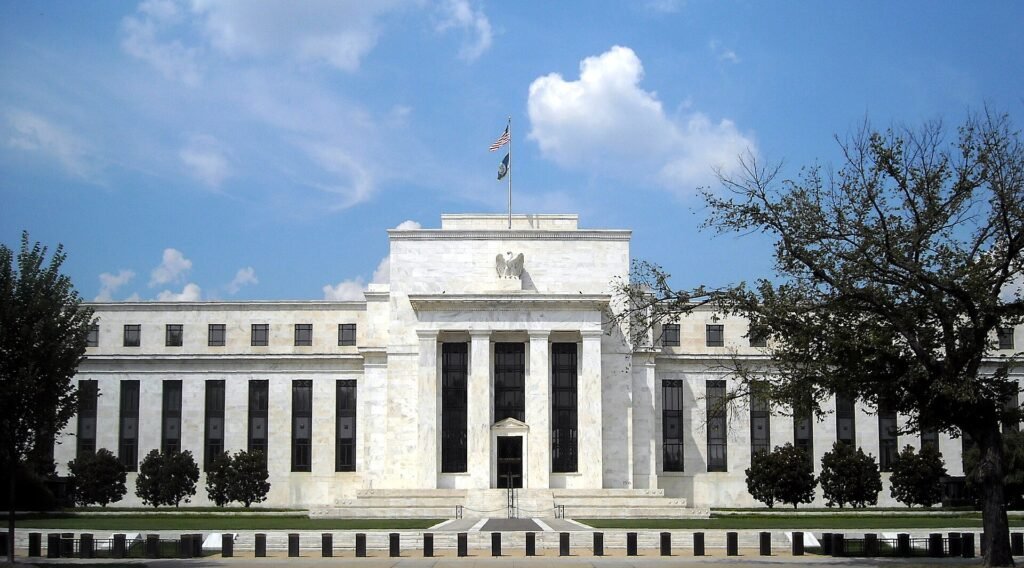
AgnosticPreachersKid · CC BY-SA 3.0 · Wikimedia Commons · Source · License
The Federal Reserve (Fed) concluded its Federal Open Market Committee (FOMC) meeting on October 28, 2026, deciding to hold the benchmark interest rate steady at the 3.75%–4.00% range. Amidst a backdrop of robust economic growth and persistent inflation concerns, Governors Lisa D. Cook and Beth M. Hammack cast dissenting votes, favoring a 0.25 percentage point increase.
Interest Rate Held at 3.75%–4.00% Following 10-2 Vote
In an official statement released on October 28, 2026, the Federal Open Market Committee announced that the target range for the federal funds rate will remain at 3.75%–4.00%. This decision is intended to support the Fed’s dual mandate of maximizing employment and maintaining price stability. The committee approved the rate hold with a 10-2 vote.
Regarding the implementation of monetary policy, the Fed continues its balance sheet policy to manage liquidity within the financial system alongside the interest rate hold. The committee reaffirmed its commitment to maintaining an “ample reserves” regime within the banking system.
Dissenting Voices: Cook and Hammack Advocate for 0.25% Point Hike
The regular meeting featured formal expressions of disagreement from two members who advocated for a tighter monetary stance. Governors Lisa D. Cook and Beth M. Hammack indicated that they would have preferred to raise the target range for the federal funds rate by 0.25 percentage points.
The statement recorded the dissenting votes of both members, noting their preference for a 1/4 percentage point increase in the federal funds rate target range.
Assessment of U.S. Economic Indicators: Domestic Spending, Productivity, and Investment
In its statement, the Fed assessed that current U.S. economic activity is expanding at a “strong pace.” While geopolitical developments continue to sustain high levels of macroeconomic uncertainty, domestic spending has demonstrated resilience.
Furthermore, the Fed noted that productivity growth remains strong and that businesses have maintained a steady trend of capital investment.
Balancing Labor Market Supply and Demand and Monitoring Inflation
Regarding labor market indicators, the Fed determined that job gains have remained consistent with the growth of the labor force. Consequently, the unemployment rate has shown stability without significant fluctuations.
Conversely, the committee noted that inflation “remains elevated.” The Fed stated it will continue to gather and evaluate additional information to inform its appropriate monetary policy stance to ensure inflation returns to its 2% target in a timely manner.
Key Highlights of the October FOMC Policy Statement
- Benchmark Interest Rate: Held at 3.75%–4.00% (10-2 vote)
- Dissenting Views: Lisa D. Cook and Beth M. Hammack (favored a 0.25%p increase)
- Economic Assessment: Strong expansion, resilient domestic spending, robust productivity, and capital investment
- Employment and Prices: Labor market balance maintained, stable unemployment, and persistent elevated inflation
- Liquidity Management: Reaffirmed commitment to an “Ample Reserves” regime
Commitment to 2% Inflation Target and Source Disclaimer
Concluding its statement, the Federal Reserve reaffirmed its policy commitment to achieving price stability. The committee plans to review incoming economic data comprehensively to take necessary steps to gradually lower inflation toward the 2% goal.
All facts and figures in this article are based solely on the official FOMC statement released by the Federal Reserve Board at 2:00 PM (ET) on October 28, 2026. As the Fed did not include individual members’ detailed remarks or internal debate transcripts in this document, specific policy context and individual qualitative judgments can only be verified through future disclosures, such as the publication of meeting minutes.
Official Source:
* Federal Reserve Board Federal Open Market Committee (FOMC) Statement (Released October 28, 2026): https://www.federalreserve.gov/newsevents/pressreleases/monetary20261028a.htm