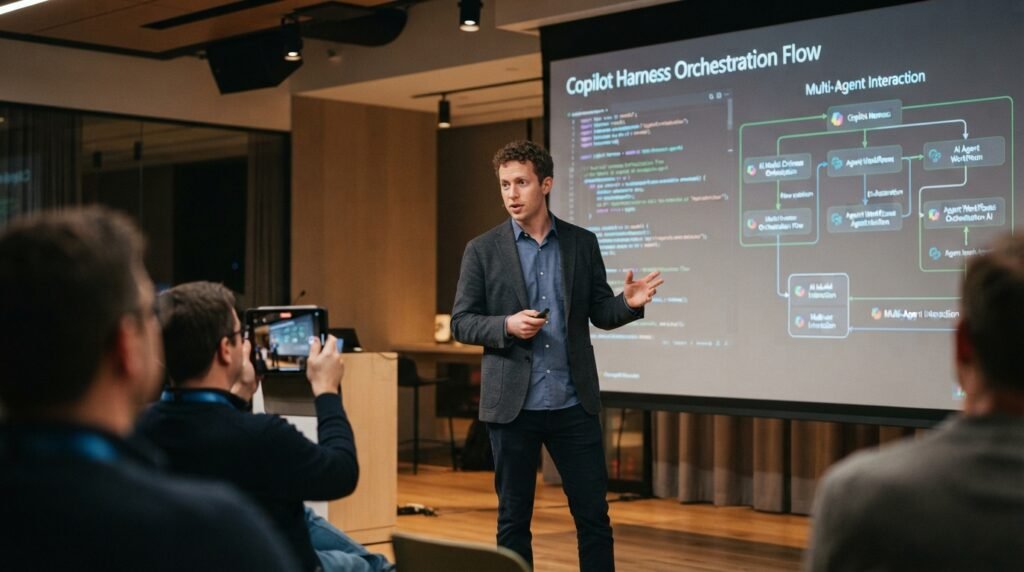
On October 28, 2026, Microsoft officially launched ‘Microsoft Copilot Harness,’ a dedicated platform designed to optimize the integrated operation of diverse AI models and autonomous agent workflows. This move makes the harness infrastructure—developed by the GitHub engineering team and utilized across Microsoft’s primary services—fully accessible to external developers and enterprise customers via ‘Microsoft Foundry.’
‘Copilot Harness’ Debuts via Foundry, Built on Core GitHub Technology
Microsoft announced the formal release of Copilot Harness on October 28, 2026, via an official company blog post authored by Tina Schuchman, Corporate Vice President of Microsoft Foundry, and Vladimir Fedorov, Chief Technology Officer at GitHub. Copilot Harness is a fully managed orchestration platform that integrates instruction establishment, tool integration, and context delivery, enabling AI models to execute complex, long-running tasks. Microsoft stated that the company has already standardized and applied this harness technology across its core product suite, including Copilot code, Copilot Studio, GitHub Copilot app, Command Line Interface (CLI), and Visual Studio Code (VS Code).
Structural Concepts and Intelligent Routing: The ‘Harness’ Around AI Models
According to Microsoft, if the AI model acts as the engine providing intelligence, the ‘Harness’ represents the entire execution and control infrastructure surrounding that model. The harness functions as an orchestration layer that consistently provides agents with precise instructions, context, execution environments, and control mechanisms to ensure tasks are completed seamlessly. Notably, Copilot Harness supports the Model Context Protocol (MCP), Agent Skills, and agent plugins as its foundational structure.
Relying on a single frontier model can leave applications vulnerable to performance fluctuations; however, Copilot Harness provides intelligent routing that automatically distributes tasks to the optimal model based on specific requirements. Developers no longer need to evaluate individual models or build their own routers; the harness layer handles model selection or combinations based on task types. This allows enterprises to reduce infrastructure maintenance burdens and focus on developing core business logic.
Performance Metrics Driven by Rust Runtime Transition and Enterprise-Wide Standardization
Microsoft initially developed this high-performance harness for multi-model orchestration within the GitHub engineering team before scaling it as the standard foundation for company-wide Copilot services. To maximize speed, token efficiency, and predictability in a rapidly evolving technological environment, Microsoft recently migrated the Copilot Harness runtime code to Rust, a high-performance programming language.
The Rust-redesigned runtime significantly reduces session overhead and drastically shortens the Time-to-First-Token (TTFT). Its stability has been proven in large-scale operational environments where millions of users and hundreds of real-world use cases intersect. Microsoft emphasized that through continuous technical investment in the harness system, both its internal products and external developers using Foundry will benefit from simultaneous performance improvements and cost reductions.
Integration of 20+ Frontier Models and Sandbox-Based Governance
Copilot Harness supports over 20 state-of-the-art frontier model families by default and offers a ‘Bring Your Own Key’ (BYOK) method, allowing developers to use their own API keys. This ensures that users are not locked into a specific AI model vendor and can autonomously combine the best models for each specific task.
Regarding operations and security, Microsoft uniquely executes and manages agent loops and security sandbox environments within Copilot Harness. Because orchestration governance, performance optimization, and control policies are provided at the system level, developers can immediately build secure autonomous agents by simply providing execution instructions, skills, integrated tools, and model preferences.
Foundry SDK Delivery and Open Ecosystem Strategy
Developers and enterprise customers can download the Software Development Kit (SDK) from Microsoft Foundry to apply it locally or within their own systems, or run the harness as a fully managed service within the Foundry cloud environment. Consistent with its principles of platform openness and interoperability, Microsoft confirmed its policy to continue allowing developers to bring and integrate third-party harnesses or frameworks if they prefer.
Limitations of Official Announcements and Verification Challenges
As this announcement is based on a corporate release via Microsoft’s official technology blog, it does not include independent third-party verification or specific cost-saving metrics from actual customer deployments. Precise differences in token consumption rates between frontier models, real-time routing efficiency, and compatibility across complex plugins remain variables that will require further validation through real-world deployments by companies utilizing the Foundry platform.
Starting with the rollout of the Copilot Harness SDK via Foundry, Microsoft plans to continue system advancements and leverage its Foundry infrastructure as a core pillar for proliferating multi-model based agentic workflows across various industries.