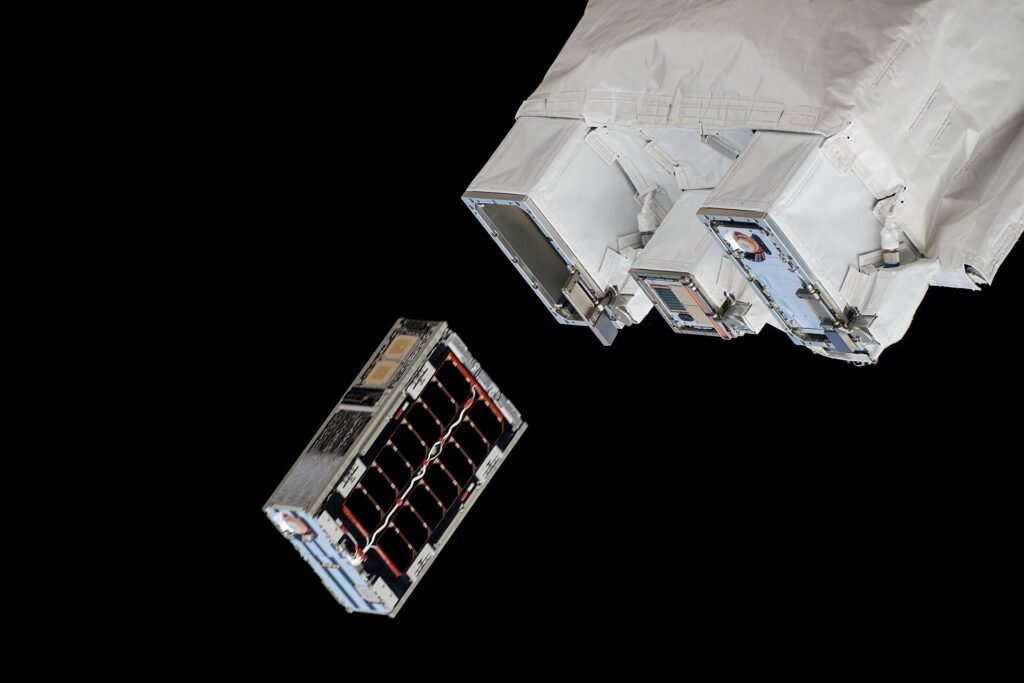
NASA Johnson Space Center · PUBLIC DOMAIN · Wikimedia Commons · Source
On October 30, 2026, Google Research officially announced that it had received the first successful artificial intelligence response from ‘Project Suncatcher,’ a prototype satellite launched into orbit to demonstrate AI computing. This marks a historic milestone, as it is the first time a data-center-grade Tensor Processing Unit (TPU) has been successfully operated in orbit to process real-time AI inference data and transmit it back to Earth.
Launch, Commissioning, and ‘Hello World’ Success
According to Travis Beals, Senior Director of the Intelligence Paradigms division at Google Research, the Project Suncatcher prototype was launched on October 1, 2026. This mission serves as the initial phase of a long-term research project exploring ways to power and operate AI computing systems in space. Following the launch, the research team spent approximately four weeks completing a rigorous commissioning checklist.
During the commissioning phase, the team successfully supplied power to the satellite’s internal host tray and TPU tray, completing initial machine learning computation tests without issue. Through these validation steps, Google researchers reached the ‘Hello World’ milestone by generating the first AI data response from a data-center-grade TPU in orbit. This confirmed that high-performance AI hardware can maintain operational integrity in the extreme environment of space.
Svalbard Ground Station and Gemma 4 Haiku Generation
The initial communication took place while the satellite passed over a ground station in Svalbard, Norway. The ground team performed an uplink of a prompt to the satellite’s onboard Google open model, ‘Gemma 4.’ The request was to write a three-line ‘Haiku’ poem about being in outer space.
As the satellite passed over the Svalbard station, it downlinked data containing the exact poem generated by Gemma 4. The received text read: “Blue marble below / Data streams in silent grace / Starlight feeds my core.” The successful reception of this downlink confirmed the proper functioning of the orbital TPU’s language model inference and text generation capabilities.
Payload Structure and Orbital Computing Mechanism
The Project Suncatcher satellite features a modular design, with a host tray for computation control and a dedicated TPU tray for performing AI inference. Immediately following the success of the first Haiku, the team conducted additional verification, including generating a Limerick about outer space and executing telemetry prompts to report on the precise technical status of the payload system.
This demonstration represents a technical shift from conventional commercial satellites—which typically utilize simple signal relays or limited central processing units (CPUs)—to the direct integration of high-performance TPU devices used in terrestrial AI data centers into a space environment. Key demonstration points include:
- Payload Power Delivery: Validation of power supply to both host and TPU trays after orbital insertion.
- Real-time Inference: Successful operation of the Gemma 4 open model using a data-center-grade TPU in orbit.
- Ground Station Signal Transmission: Successful uplink of prompts and downlink of generated data while passing over the Svalbard ground station.
Radiation/Thermal Stress Evaluation and 2027 Twin Satellite Roadmap
Following this initial success, Google Research will begin a precise evaluation of environmental risks specific to orbit. Space presents challenges such as difficulties with heat dissipation in a vacuum and exposure to intense cosmic radiation. The team will evaluate how the TPU hardware maintains computational accuracy and avoids technical failure when exposed to extreme thermal stress and high-energy radiation particles.
Once the durability of the single prototype is verified, Google plans to advance to the next milestone. According to Travis Beals, the team is planning a follow-up mission in 2027 to launch two ‘twin interconnected satellites’ into orbit. This will allow for the integrated demonstration of satellite-to-satellite communication networks and distributed AI computing systems in space.
Limitations of Official Reporting and Future Challenges
This report is based on a single official account published by Senior Director Travis Beals on the Google Research blog on October 30, 2026. As this is an independent project led by Google, it lacks verification data from third-party institutions. Furthermore, while Project Suncatcher has succeeded in its initial commissioning and text downlink, long-term quantitative data regarding thermal control and radiation shielding performance remain tasks for future demonstration tests.
For space-based AI computing to eventually augment commercial data centers or serve as infrastructure for autonomous space exploration, the 2027 twin-satellite test and the long-term reliability of in-orbit TPUs will be critical turning points.