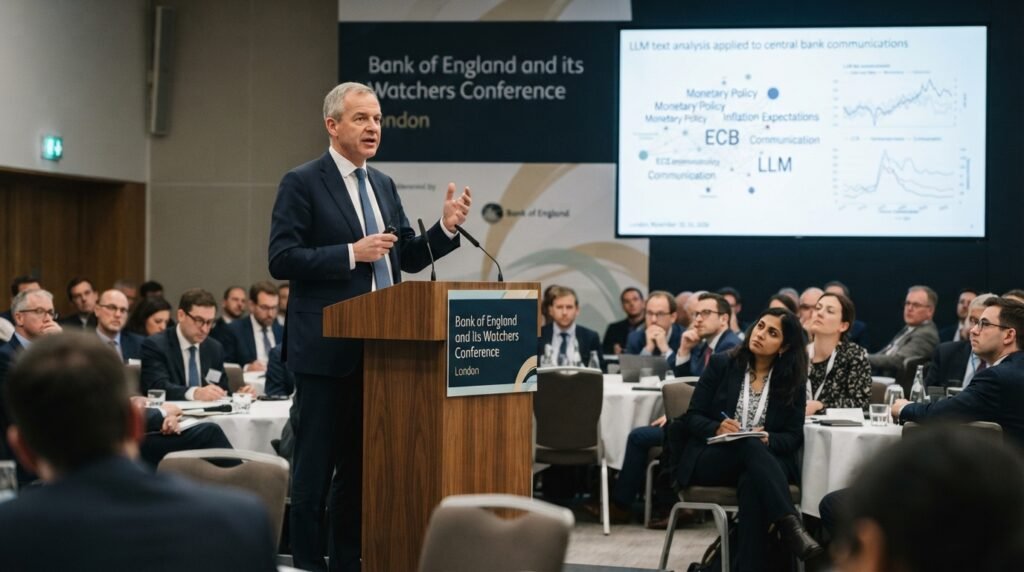
European Central Bank (ECB) Executive Board Member Philip R. Lane officially presented the empirical results and practical applications of monetary policy communication during his keynote speech at the ‘Bank of England and its Watchers Conference’ held in London on November 10, 2026. Lane emphasized that, according to analyses using Artificial Intelligence (AI) and Large Language Models (LLMs), central bank verbal messaging serves as more than just a vehicle for delivering interest rate decisions—it exerts an independent and sustained impact on financial market pricing, inflation expectations, and macroeconomic real indicators.
LLM-Based Text Analysis and Validation of Monetary Policy Rules
In his opening remarks, Philip Lane noted that the analysis of central bank communication has reached a turning point with the integration of AI and LLMs, moving beyond legacy word-frequency or dictionary-based extraction methods. By applying state-of-the-art LLM frameworks that comprehensively grasp contextual nuances, the ECB can now quantify the sentiment shifts within official statements and speeches in real time.
Empirical analysis by ECB internal researchers shows that the central bank’s communication sentiment index exhibits a high degree of co-movement with policy rate (deposit facility rate) tightening and easing cycles. Notably, message indicators extracted from policy statements, even after controlling for Eurosystem and internal ECB forecasts, significantly enhance the ability to predict the flow of Eurozone core inflation several quarters ahead.
Furthermore, Lane explained that the ECB’s communication framework is not arbitrary but follows structured ‘communication rules.’ Regression analysis linking economic activity sentiment and price sentiment reveals that, in line with its primary mandate of price stability, the ECB’s messaging has systematically operated with significantly higher weight placed on inflation trends rather than real economic activity.
Financial Market Interest Rate Formation and Cumulative Message Effects Between Meetings
Lane pointed out that market participants readjust their asset prices and investment strategies based not only on policy announcements but also on signals regarding future economic conditions and policy paths provided by the central bank. Even if the interest rate decision itself aligns with market expectations and does not trigger immediate price volatility, the accompanying communication can fundamentally shift market assessments of the restrictive nature of policy.
- Cumulative effect of inter-meeting speeches: Speeches, interviews, and parliamentary hearings by executive board members during the periods between scheduled Governing Council meetings exert a persistent influence on market yields across maturities.
- Long-term yield formation: Communication prior to tightening cycles assists the market in anticipating rate hikes and exerts an effect comparable to scheduled announcements in adjusting risk premiums for long-term government bonds and risky assets.
- Three-factor decomposition of news: Financial markets reflect central bank communication by categorizing it into three core factors: target policy rates, future interest rate paths, and market/sovereign risks.
These high-frequency data analysis results demonstrate that traditional methods, which only measure short-term market reactions on the day of a policy decision, may underestimate the total impact of central bank communication.
Communication Gaps and Household Borrowing Cost Bias
Structural differences exist in the process of conveying policy messages to the general public versus financial market professionals. Citing data from the 2021 ECB monetary policy strategy review, Lane noted that only about 10% of consumers were aware of the new inflation target within months of its announcement. The majority of households received related news through mass media channels such as TV, radio, and newspapers rather than official ECB outlets.
Economic agents exhibit ‘rational inattention,’ where interest in inflation fluctuates depending on the macroeconomic environment. While household and business interest in price levels spikes during high inflation, it significantly wanes during periods of low-inflation stability. In inflationary times, interest is high but responsiveness to existing information may diminish, requiring central banks to tailor communication strategies to the prevailing economic climate.
Moreover, Eurozone consumers tend to interpret monetary policy shifts more directly as changes in borrowing costs—such as mortgage rates—rather than as tools for inflation control. Households that perceive the borrowing cost channel more strongly were found to exhibit a more sensitive reaction in reducing spending during rate hikes.
Macroeconomic Ripples of Communication Shocks and Practical Limitations
ECB Executive Board Member Philip Lane explained that quantitative analysis confirms unexpected shifts in monetary policy communication (‘communication shocks’) have a direct impact on the Eurozone’s industrial production and the Harmonised Index of Consumer Prices (HICP). While these shocks produce smaller, more delayed initial effects compared to direct interest rate changes, they act as significant drivers for real macroeconomic indicators.
However, Lane warned that rigorous validation is essential when applying LLM and AI analytical techniques. Because text analysis results can be sensitive to prompt engineering and the composition of training data, he stressed that strict in-house validation procedures must accompany any support for central bank policy judgment.
Lane emphasized that the ECB will continue to advance its communication framework with markets and the public, and will persistently validate the operating mechanisms of its communication rules, even during phases of inflation stabilization.
Official Sources and Related Publications
This article is based on the speech materials released by the European Central Bank (ECB) on November 10, 2026, by Executive Board Member Philip Lane.
- Official ECB Speech (November 10, 2026): Philip R. Lane: The science and practice of monetary policy communication: the ECB experience