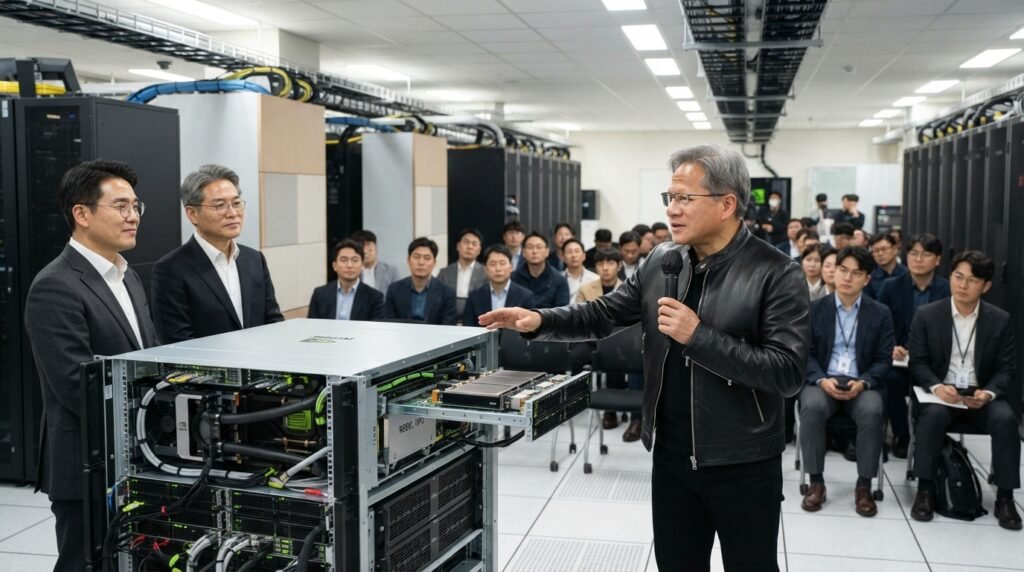
On November 8, 2026, NVIDIA, South Korean AI semiconductor startup Rebellions, and SK Telecom officially announced a three-way partnership to build a Korean sovereign AI infrastructure based on NVIDIA’s open infrastructure platform, ‘NVLink Fusion.’ This partnership aims to strengthen national-level sovereign AI competitiveness by combining domestically designed AI semiconductors, global high-speed interconnect technology, and SK Telecom’s data center and model capabilities.
Integrating NVLink Fusion with Domestic NPU Rack-Scale Architecture
According to the official NVIDIA Newsroom press release, Rebellions has agreed to directly integrate its next-generation neural processing unit (NPU), the ‘Rebel R200,’ with NVIDIA’s NVLink Fusion platform. NVLink Fusion is a high-performance interconnect platform that extends NVIDIA’s vertically integrated infrastructure ecosystem to custom XPU and ASIC partners, enabling partner-specific semiconductors to connect to NVIDIA’s high-bandwidth, low-latency scale-up network.
Rebellions plans to develop an R200 NPU-based rack-scale system by adopting NVIDIA’s ‘MGX’ rack architecture reference design. By incorporating the MGX ecosystem, Rebellions can utilize existing original design manufacturer (ODM) and supply chain networks to reduce productization risks for domestic AI semiconductors and accelerate time-to-market.
Implementing Disaggregated Inference Mechanisms
The three partners will apply a ‘disaggregated inference’ approach to maximize computational and power efficiency when running advanced models, such as Mixture-of-Experts (MoE) models with trillions of parameters. This mechanism splits the AI response generation process into stages, assigning each task to the semiconductor architecture best optimized for its specific nature.
For the ‘prefill’ stage, which handles input context and prompts, NVIDIA GPUs are deployed due to their strength in massively parallel computation. For the ‘decode’ stage, which sequentially generates actual text tokens, Rebellions’ R200 NPU is utilized for its low-latency, high-efficiency characteristics. This division of roles significantly enhances overall throughput and improves power consumption efficiency in large-scale inference environments.
SK Telecom AI Data Center Deployment and Model Integration
Building on its experience in constructing and operating AI data centers, SK Telecom plans to deploy the computing systems based on the MGX rack architecture into its own AI data centers. The MGX standard rack architecture allows GPU and NPU systems to share data center design elements such as rack space, power supply modules, and cooling facilities.
The established sovereign AI infrastructure will be directly linked to SK Telecom’s proprietary large language model, ‘A.X K2,’ and will serve as the computational foundation for public and private AI services promoted through the South Korean government’s ‘AI for All’ project. Through this, SK Telecom is pursuing a full-stack sovereign AI strategy that encompasses infrastructure, proprietary models, and services.
Policy Support from the MSIT and Statements from Leadership
This collaboration is supported by the Ministry of Science and ICT (MSIT) of South Korea’s policies for fostering domestic AI semiconductors and strengthening sovereign AI infrastructure.
Jensen Huang, founder and CEO of NVIDIA, stated that by utilizing NVLink Fusion, South Korea will build a computing foundation that connects its own chips to the NVIDIA AI Factory platform, allowing the nation to transform its language, culture, and industrial expertise into intelligent assets. Park Sunghyun, co-founder and CEO of Rebellions, emphasized that connecting South Korea’s AI semiconductors and models with global system technology will open a new chapter for high-efficiency inference. Jung Jae-heon, CEO of SK Telecom, declared that they would prove their full-stack sovereign AI competitiveness through the combination of global infrastructure technology and domestic semiconductors. Bae Gyeong-hoon, Minister of Science and ICT, added that this serves as a crucial turning point for Korean NPUs to enter the global infrastructure market and that the government intends to expand cooperation into various areas, including physical AI and GPU supply acquisition.
Commercialization Timeline and System Integration Outlook
The R200 NPU-based system by Rebellions is scheduled to undergo system design and integration with the goal of deployment in actual data centers by 2028. Next-generation infrastructure construction and development tasks will be fleshed out in phases according to the announced collaborative framework.
Official Source Information
This article was written based on public documents from the official organizations and companies listed below.
- NVIDIA Official Newsroom Press Release (Published Nov 8, 2026): NVIDIA, Rebellions and SK Telecom Announce Collaboration to Advance Sovereign AI Infrastructure With NVIDIA NVLink Fusion