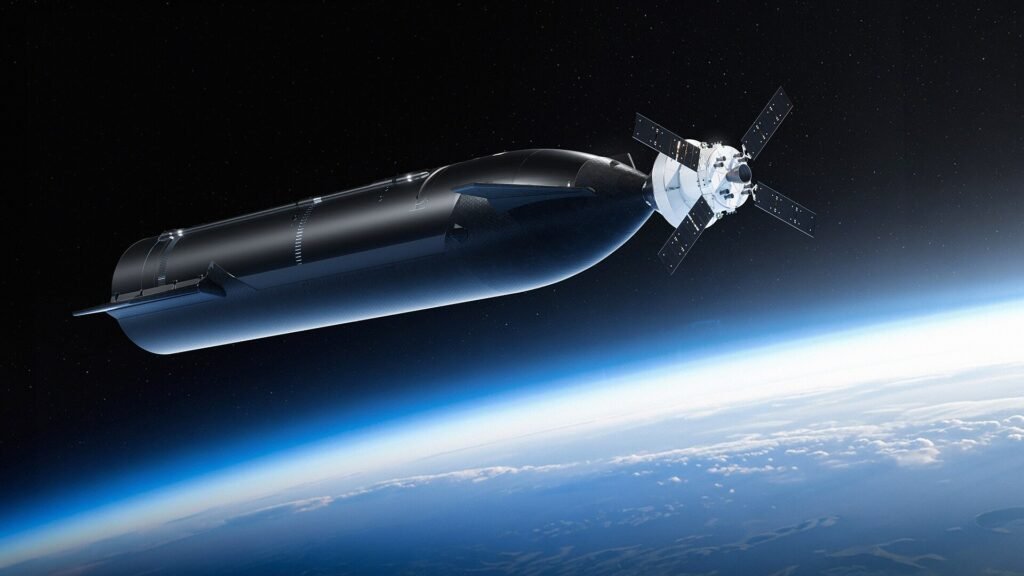
NASA/SpaceX · PUBLIC DOMAIN · Wikimedia Commons · Source
On October 23, 2026, NASA officially announced a restructuring of the Artemis lunar exploration program. The agency will transition the 2027 Artemis III mission into a Low Earth Orbit (LEO) test flight, with a human lunar landing now slated for 2028. This shift is a strategic move to mitigate technical risks associated with the commercial landers currently under development by Blue Origin and SpaceX, and to validate critical spacecraft docking procedures, thereby increasing the success rate of humanity’s return to the Moon.
2027 Artemis III to Conduct LEO Lander Docking Demonstration
According to NASA, the 2027 Artemis III mission will not land on the lunar surface. Instead, it will feature a roughly 14-day large-scale demonstration mission, launching four astronauts aboard the Orion spacecraft into LEO. The crew will include NASA astronauts Randy Bresnik, Frank Rubio, and Andre Douglas, alongside European Space Agency (ESA) astronaut Luca Parmitano. Unlike previous missions that relied on a single launch, Artemis III will utilize a complex operational model involving the sequential launch of three different heavy-lift rockets over a short period.
The mission begins with the launch of a Blue Origin ‘Blue Moon Mark 2’ lander test article into a circular LEO at an altitude of approximately 273 miles (about 439 km). Subsequently, an Orion spacecraft, launched atop a Space Launch System (SLS) rocket from Kennedy Space Center, will perform orbital maneuvers to achieve thermal stability at an altitude of 345 miles (about 555 km) before docking with the Blue Moon test article. After docking, the astronauts will enter the Blue Moon for two days to inspect habitability, life support systems, and pressure maintenance, marking the first time a crew will evaluate the space-based interoperability of a commercial human lander and Orion.
SpaceX Starship Docking Demonstration and Additional LEO Tasks
Following the completion of the Blue Origin validation, Orion will undock and proceed to a second rendezvous and docking attempt with a ‘Starship Version 3’ test article launched by SpaceX. Orion will connect with the Starship’s forward docking system while the vehicle waits in a 206-nautical-mile (about 381 km) orbit, assessing controllability, communications, integrated software, and docking dynamics for up to two hours. During this Starship test, the crew will not enter the vehicle, but will instead test distinct docking geometries as Orion validates both Blue Moon’s side port and Starship’s forward port.
After the two docking demonstrations, the Orion crew will remain in LEO for up to five days to conduct further spaceflight tests. This period will include evaluations of Orion crew survival suits, testing of docking sensors, collection of thermal and acoustic data, cellular biology experiments, and validation of lunar sample return concepts. Following the mission, the Orion spacecraft will re-enter the Earth’s atmosphere and splash down off the coast of California, where NASA and the U.S. Navy will conduct precise recovery operations.
Push for 2028 Lunar Landing and Fundamental Shift in Orbital Operations
Building on the results of the Artemis III LEO test flight, NASA is pushing forward with a human lunar landing in 2028. NASA Administrator Jared Isaacman stated that, in accordance with the President’s national space policy, the organization is mobilizing all resources to achieve the goal of returning U.S. astronauts to the Moon and establishing a Moon Base by 2028. NASA has abandoned the previously planned Near-Rectilinear Halo Orbit (NRHO) docking approach, adopting a new Concept of Operations (ConOps) tailored to the technical characteristics of each company’s lander.
SpaceX’s Starship HLS will aggregate cryogenic propellant from a depot in LEO before docking with Orion. The Starship will then perform the Trans-Lunar Injection (TLI) to propel the combined stack directly to Low Lunar Orbit, reducing the number of tanker launches and operational risks. Meanwhile, Blue Origin has adopted a multi-stage approach, combining the Blue Moon Mark 2 Alpha lander and three-stage transfer modules to move into an elliptical polar orbit before docking with the SLS-launched Orion for the final descent to the lunar South Pole.
Streamlining Commercial Contracts and Enhancing Safety Protocols
Through this reorganization, NASA has renegotiated its Human Landing System (HLS) contract terms with Blue Origin and SpaceX. Previously, Artemis III and IV were assigned exclusively to SpaceX, and Artemis V to Blue Origin. Under the new terms, specific missions are no longer pre-assigned to individual companies; the primary contractor for the first 2028 lunar landing will be determined based on the performance and technical readiness demonstrated during the 2027 LEO flight test.
To prioritize astronaut safety, flight and ground verification milestones for both companies have been strengthened. Both firms must complete uncrewed demonstration flights before proceeding to a crewed landing, and must pass NASA’s final system certification.
- Additional SpaceX Milestones: Two demonstration tests for ‘Cabin 1,’ the Starship HLS crew living area.
- Additional Blue Origin Milestones: Implementation of new human-in-the-loop testing and hardware readiness evaluation phases.
- 2028 Lunar Surface Mission Goal: Two 2-hour spacewalks near the lunar South Pole and field testing of next-generation Axiom Space spacesuits.
Future Outlook and Deep Space Infrastructure
Jeremy Parsons, NASA Artemis Program Manager, emphasized, “Launching three different rockets and three spacecraft to dock and operate in LEO simultaneously is a complex operation unlike anything NASA has attempted before.” By successfully executing the 2027 LEO mission and the 2028 crewed lunar landing, NASA plans to move beyond one-off visits to build sustainable infrastructure on the lunar surface, laying the foundation for future human exploration of Mars.
Official Sources: