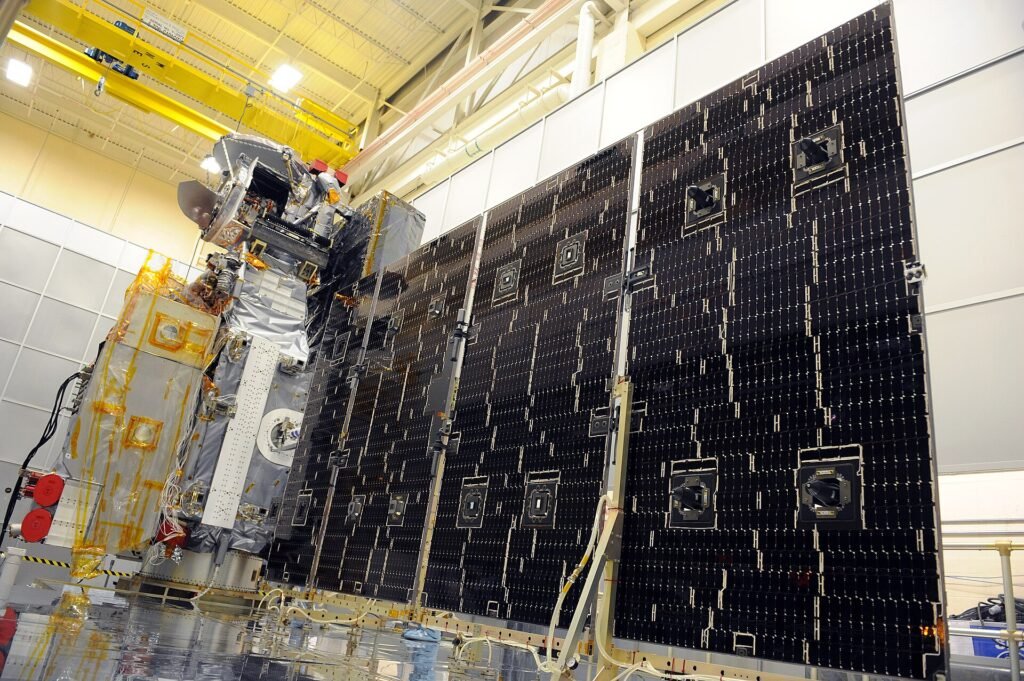
NASA Goddard · PUBLIC DOMAIN · Wikimedia Commons · Source
On October 26, 2026, the European Space Agency (ESA) announced that CRISTAL (Copernicus Polar Ice and Snow Topography Altimeter), the next-generation polar monitoring satellite for the Copernicus program, has completed the integration of its solar arrays and key verification procedures, marking its transition into the environmental testing phase. The CRISTAL satellite is equipped with a dual-frequency radar altimeter and a microwave radiometer, tasked with observing changes in polar ice and snow.
Airbus Assembly Completion and Solar Array Deployment Test
Engineers at the Airbus facility in Friedrichshafen, Germany, successfully finalized the assembly of the CRISTAL satellite in September 2026. Following assembly, the technical team initiated functional testing to verify the operational integrity of the satellite’s systems.
A critical milestone in this validation was the successful first solar array deployment test. This procedure is essential for confirming that the mechanical mechanisms and control software sequences function as planned when the satellite deploys its solar wings after reaching orbit. By verifying the seamless operation of both the deployment mechanism and the software, Airbus and ESA researchers have completed a major milestone for the upcoming space mission.
Launch Adapter Separation Demonstration and Intermediate Qualification Status Review
In collaboration with launch service provider AVIO, further tests were conducted to verify that the CRISTAL satellite correctly integrates with the launch vehicle adapter. This adapter secures the satellite to the rocket, and the test ensured the precise operation of the separation mechanism required to safely deploy the satellite into orbit.
Concurrently, the project team conducted an ‘Intermediate Qualification Status Review,’ a comprehensive system-level check. This review evaluated the qualification and validation status of onboard equipment, observation sensors, and subsystems ahead of upcoming environmental stress testing. Kristof Gantois, CRISTAL Project Manager at ESA, stated that the satellite passed all tests with excellent results, laying a solid foundation for the next stage of validation.
Transfer to the Netherlands and Environmental Testing/Launch Schedule
Having completed testing at the Airbus facility in Friedrichshafen, the CRISTAL satellite is scheduled to be transported to the European Space Research and Technology Centre (ESTEC) in the Netherlands. The satellite will spend much of 2027 at the center, undergoing rigorous environmental testing to ensure it can withstand the shocks of launch and the harsh conditions of space.
The target launch window for CRISTAL is set for late 2027 to early 2028. Upon successful deployment, CRISTAL will become the first of the EU’s Copernicus Sentinel Expansion missions to reach space.
Next-Gen Dual-Frequency Radar and Observation Mechanisms
The satellite’s official name is the ‘Copernicus Polar Ice and Snow Topography Altimeter.’ CRISTAL features a unique combination of the first dual-frequency radar altimeter and a microwave radiometer.
These instruments will allow the satellite to precisely measure and monitor sea-ice thickness, the depth of snow cover over sea ice, and changes in the elevation of continental ice sheets and glaciers. This data will contribute to a more accurate understanding of how polar environmental shifts impact the entire planet.
Over 20 Years of Data Continuity and Future Operational Plans
The CRISTAL mission aims to maintain the records of radar altimetry for ice elevation and topographic variability—established by ESA’s CryoSat mission and existing observation satellites—for at least the next 20 years.
To ensure seamless data collection, ESA plans to launch a follow-up satellite, ‘CRISTAL-B,’ as the operational lifespan of the initial ‘CRISTAL-A’ unit nears its conclusion. The collected observation data will be utilized for marine activities, such as navigation in polar waters, coastal and inland water monitoring, ocean topography analysis, and understanding climate change processes.
Official Source
ESA Official Announcement (October 26, 2026): https://www.esa.int/Applications/Observing_the_Earth/Copernicus/Ice_mission_CRISTAL_opens_its_wings