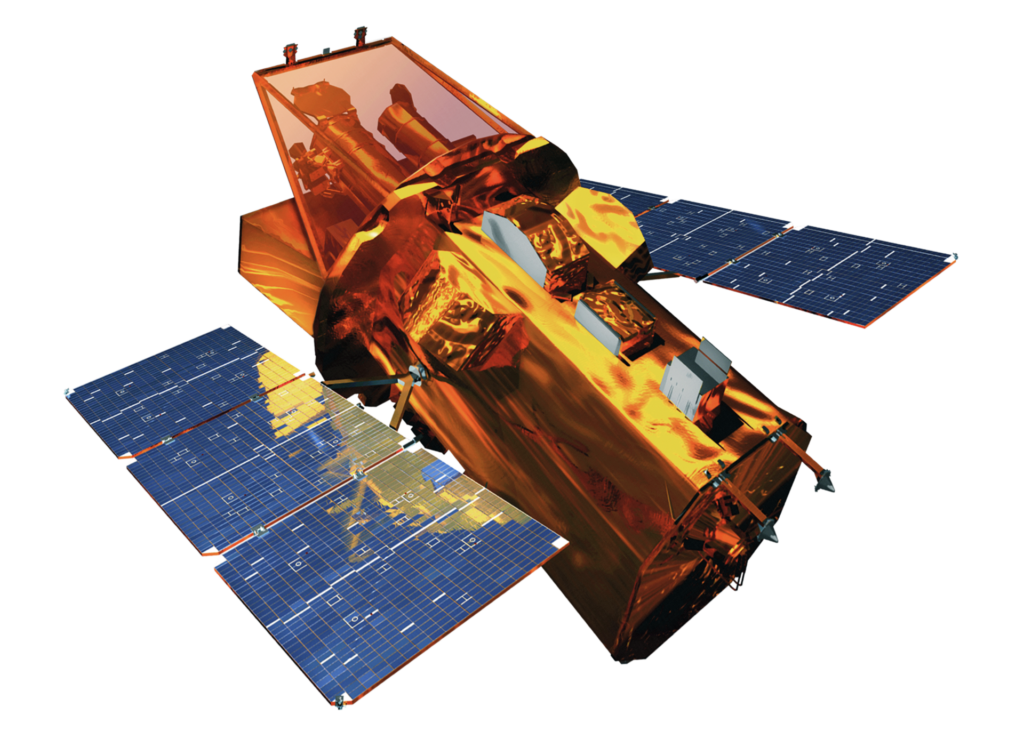
NASA E/PO, Sonoma State University/Aurore Simonnet · PUBLIC DOMAIN · Wikimedia Commons · Source
NASA’s Neil Gehrels Swift Observatory has officially concluded its scientific mission after performing its final observation on October 20, 2026. The observatory’s orbit decayed to below 171 miles (approximately 275 km), where atmospheric drag prevented the spacecraft from maintaining stable orientation toward its observation targets. In a statement on October 23, NASA announced that Swift is expected to re-enter Earth’s atmosphere and burn up within the coming weeks. Launched on November 20, 2004, the observatory operated for nearly 22 years, far exceeding its original two-year primary mission duration, while monitoring high-energy cosmic explosions.
Mission Conclusion and 22 Years of Operation
The Swift observatory was originally designed for a two-year primary mission following its launch into Earth orbit on November 20, 2004. However, it operated successfully for nearly 22 years—over 10 times its planned lifespan—leading the field of high-energy astronomy by tracking transient cosmic phenomena.
Dr. Shawn Domagal-Goldman, director of the Astrophysics Division at NASA Headquarters, noted that Swift continuously demonstrated immense national scientific value. He emphasized that the mission not only played a critical role in expanding our understanding of the changing universe but also stood at the center of innovation by demonstrating the vital importance of rapid-response observational systems to the global astronomical community.
Tracking Over 2,000 Gamma-Ray Bursts and a 12-Terabyte Scientific Archive
During its operational life, Swift captured more than 2,000 gamma-ray bursts (GRBs), the most powerful explosions in the universe. Additionally, it collected multi-faceted data on over 1,400 supernova explosions, stars destroyed by black holes, monitoring of active galaxies, all-sky X-ray surveys, and studies of asteroids and comets. These observational data have served as core materials for approximately 7,000 academic papers published to date.
- Official Mission End Date: Final observation conducted on October 20, 2026 (NASA official announcement on October 23)
- Reason for Mission Conclusion: Increased atmospheric drag and inability to point due to orbital decay below 171 miles (275 km)
- Cumulative Scientific Achievements: Over 2,000 GRBs, 1,400+ supernovae, and contributions to approximately 7,000 academic papers
- Data Archive: Over 1.5 million images from UV/optical telescopes, with a total of 12 terabytes of data fully released
The scientific archive accumulated by Swift over 22 years includes brightness measurements of cosmic explosions, multi-wavelength spectra, and over 1.5 million images captured by its Ultraviolet/Optical Telescope (UVOT). The total data volume is approximately 12 terabytes (TB)—equivalent to about 600 high-definition (HD) movies—and has been released in full as a public archive in accordance with NASA’s Open Science policy, supporting new academic discoveries for decades to come.
Precision Pointing Mechanism and Decoding Short Gamma-Ray Bursts
Swift’s unparalleled success was due to its multi-wavelength observation structure, which housed optical/ultraviolet and X-ray telescopes on the same axis. Upon detecting a gamma-ray burst, the spacecraft was capable of rotating its entire frame to capture precision images within about one minute, before the afterglow faded.
Dr. S. Bradley Cenko, principal investigator at NASA’s Goddard Space Flight Center, highlighted the identification of the nature of short gamma-ray bursts—those reaching peak brightness in less than two seconds—as one of Swift’s signature achievements. In May 2005, Swift captured ‘GRB 050509B,’ a short GRB lasting only 0.03 seconds, and successfully detected 11 X-ray photons. This marked the first instance of an afterglow being detected for a short GRB, confirming the theoretical model that these bursts originate from the merger of two neutron stars.
Furthermore, according to Professor John Nousek, mission operations director at Pennsylvania State University, Swift possessed a flexible planning system capable of changing targets via ground command in just minutes. This system scheduled up to 75 independent targets per day, responding in real-time to urgent observational requests from astronomers worldwide.
NASA’s Asset Strategy to Minimize Follow-up Observation Gaps
The observatory was renamed the ‘Neil Gehrels Swift Observatory’ by NASA in 2018 to honor the legacy of its first principal investigator, Dr. Neil Gehrels, following his passing.
In accordance with pre-planned strategies for the mission’s conclusion, NASA is exploring the use and complementary capabilities of existing orbital space telescope assets to minimize observation gaps. This includes leveraging commercial spacecraft capabilities that can be deployed rapidly and utilizing efficient, innovative small-satellite mission strategies.