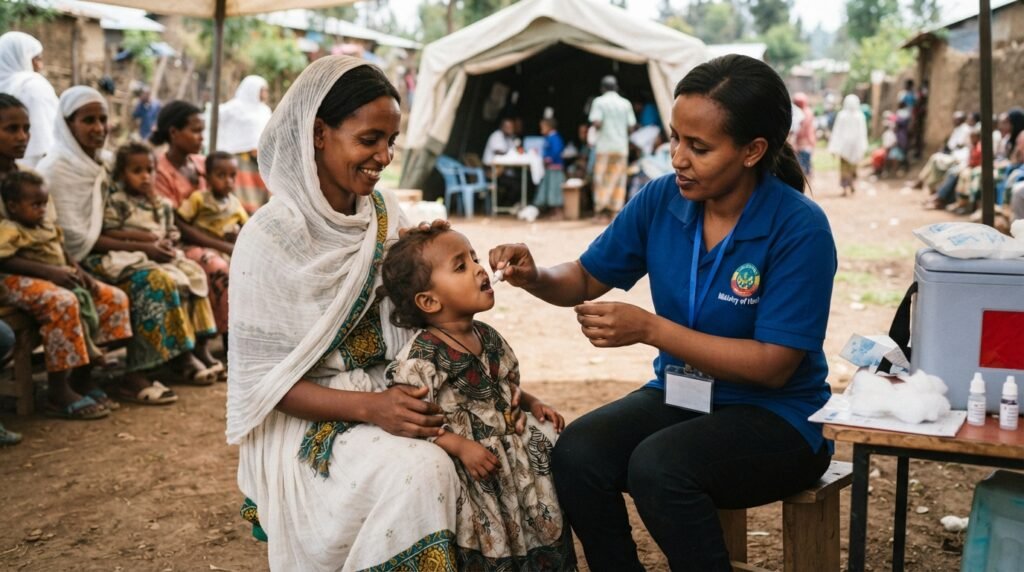
The Ethiopian Ministry of Health and partners of the Global Polio Eradication Initiative (GPEI), including the World Health Organization (WHO), announced a nationwide mass vaccination plan and strengthened surveillance measures on October 24, 2026, in observance of World Polio Day. This announcement marks a significant public health milestone, aimed at curbing the spread of recently detected variant polioviruses and providing intensive immunization for over 11 million children to secure a polio-free future for the nation.
Marking World Polio Day and the 2026 Ethiopian Epidemiological Context
On October 24, 2026, the WHO Ethiopia office, representing GPEI and health partners, issued a joint statement in Addis Ababa under this year’s theme: “One day, one focus, Ending polio for good.” While Ethiopia officially ended indigenous wild poliovirus (WPV) transmission in 2001 and received wild polio-free certification in 2017—having stopped the last imported case in 2014—the country continues to face outbreaks of circulating vaccine-derived poliovirus type 1 (cVDPV1) in remote areas with low immunization coverage.
According to the official report, 11 cases of cVDPV1 were confirmed across Ethiopia in 2026. The cases were concentrated in the Gambella region (5 cases), West Shoa Zone of Oromia (4 cases), and one case each in the Gofa and Gardule zones of South Ethiopia. Health authorities have launched urgent response measures to address the genetic mutation of the weakened virus contained in oral vaccines, which can circulate in areas where children remain unvaccinated.
Successful Outbreak Response in Gambella and Coordination with South Sudan
With financial support from WHO, UNICEF, the U.S. Centers for Disease Control and Prevention (CDC), and other GPEI partners, the Ethiopian Ministry of Health and the Ethiopian Public Health Institute (EPHI) successfully completed two rounds of bivalent oral polio vaccine (bOPV) campaigns to contain the virus in the Gambella region. This emergency initiative covered Gambella, as well as the Benishangul Gumuz region and the West Wollega and Kelem Wollega zones of Oromia.
The campaign reached over one million children under five, achieving near 100% administrative coverage. Notably, the initiative identified “zero-dose” children who had never received vaccines, providing them with essential routine immunizations. Furthermore, the Republic of South Sudan, which shares a border with Ethiopia, conducted synchronized vaccination efforts to maximize the effectiveness of the cross-border containment strategy.
Next-Generation Vaccination Campaign Targeting 11.3 Million Children
The Ethiopian health authorities are launching a second mass outbreak response targeting the South Ethiopia and Oromia regions, along with other high-risk neighboring areas. This new campaign utilizes both the bivalent oral polio vaccine (bOPV) and the novel oral polio vaccine type 2 (nOPV2) to prevent virus importation and resurgence.
The specific plans and target data for this health measure are as follows:
- Target Scope: 68 zones and 629 Woredas across 5 regions: Addis Ababa, Central Ethiopia, Oromia, South Ethiopia, and Southwest Ethiopia.
- Total Target Population: 11,348,548 children under the age of 5 (with the age limit extended to children under 10 in the West Shoa Zone, Oromia, the site of recent infections).
- Round 1 Schedule: November 20 – November 23, 2026 (4 days).
- Round 2 Schedule: December 18 – December 21, 2026 (4 days).
Success in Eliminating Type 2 Polio and Strengthening Border Surveillance
In this announcement, health authorities and the GPEI officially confirmed the successful interruption of circulating vaccine-derived poliovirus type 2 (cVDPV2) transmission within Ethiopia. The last case of type 2 poliovirus was reported on October 7, 2025; with no additional cases confirmed in over a year, authorities view the containment of the type 2 virus as stable.
WHO and its global partners emphasized that maintaining these gains while eradicating the type 1 variant requires intensified cross-border surveillance. Given the high volume of movement across borders, the strategy includes significantly bolstering Acute Flaccid Paralysis (AFP) surveillance, environmental/sewage monitoring, and real-time information sharing through community-based surveillance networks.
International Partnerships and Future Objectives
The national plan involves collaboration between core GPEI institutions such as WHO, UNICEF, CDC, Gavi, the Vaccine Alliance, Rotary International, and the Bill & Melinda Gates Foundation, as well as specialized global health organizations like the CORE Group, JSI, PATH, and CHAI. Health authorities commended the dedication of local leaders and field health workers, reiterating their commitment to ensuring complete vaccine accessibility so that no child is left behind.
Ethiopia’s core objective for the remainder of 2026 is to successfully execute the two nationwide rounds of vaccination in November and December and to improve the precision of border monitoring, aiming to permanently break the chain of transmission for the variant virus.
Official Source: WHO Africa – Ethiopia World Polio Day 2026 Statement