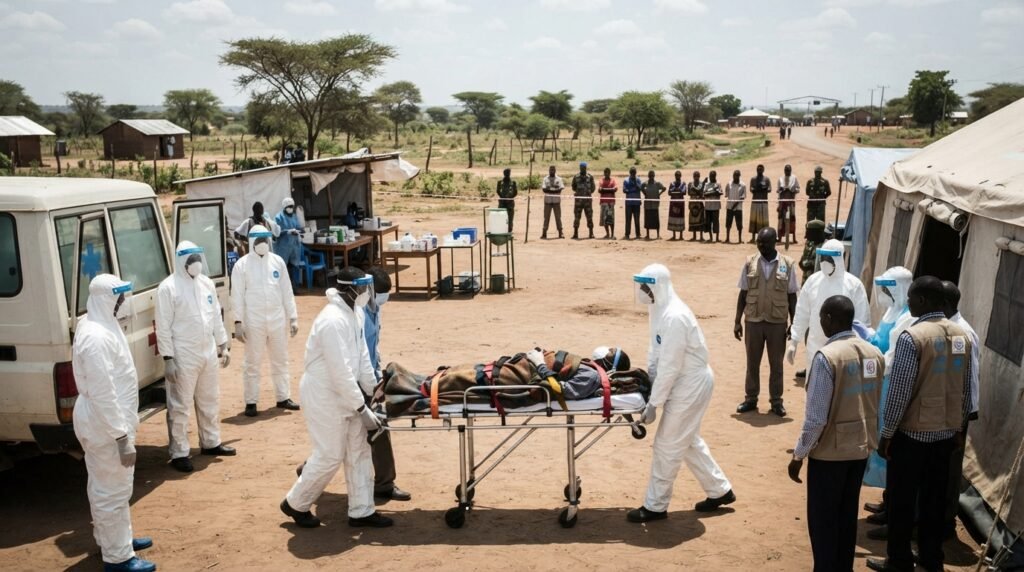
The South Sudan Ministry of Health and the National Public Health Institute (NPHI), in collaboration with international partners such as the World Health Organization (WHO), announced on October 26, 2026, the successful completion of a five-day large-scale simulation exercise (SIMEX) to prepare for the potential cross-border entry of the Bundibugyo ebolavirus (BVD). Given the ongoing outbreaks in neighboring countries like the Democratic Republic of the Congo, Uganda, and Kenya, this exercise marks a significant milestone in strengthening national biosecurity by validating response systems—ranging from early detection to isolation, treatment, and containment.
Five-Day Exercise Across Juba, Yei, and Yambio Hubs
South Sudanese health authorities and the NPHI partnered with international organizations including the WHO, Africa Centres for Disease Control and Prevention (Africa CDC), UNICEF, the International Organization for Migration (IOM), and the FHI 360 STRIDES project to conduct the comprehensive drill from October 19 to 24, 2026. The simulation took place simultaneously across 10 forward-operating sites (four in Juba, three in Yei, and three in Yambio), all under the integrated management of a central command and control center.
The field operation involved over 100 personnel, including staff from the Ministry of Health, NPHI, and health implementation partners. Nine facilitators, nine evaluators, and nine observers were deployed to each hub to conduct rigorous assessments. Participants responded to virtual scenarios involving multiple suspected Ebola cases, executing the entire response chain in real-time, including activating the Public Health Emergency Operations Center (PHEOC), managing Points of Entry (POE), utilizing emergency hotlines, and performing patient evacuations.
National Readiness at 72.5%… 23 Suspected Cases Isolated from 71 Alerts
Dr. Ader Macar Aciek, Executive Director of the South Sudan National Public Health Institute, stated that as of October 2026, South Sudan’s aggregate readiness for Ebola reached 72.5% across 11 key technical areas. He explained that the core objective of the SIMEX was to ensure that these 11 sectors possess the required speed, technical precision, and organic cooperation necessary before any actual viral entry.
To date, there have been zero confirmed cases of the Bundibugyo ebolavirus in South Sudan. However, authorities have maintained an active surveillance network covering 15 high-risk counties bordering the DRC and Uganda, which has triggered 71 alerts. Of these, 23 high-probability suspected cases were identified, safely isolated in designated zones, and tested at the National Public Health Laboratory, with all results returning negative.
Validating End-to-End Protocols: From Specimen Transport to Safe Burials
The simulation meticulously tested the technical mechanisms required to prevent transmission among healthcare workers and the community. Resources and field guidelines were pressure-tested against randomized scenarios.
- PPE and Disinfectant Protocols: Verification of standard donning and doffing procedures and the precision of chlorine dilution for on-site disinfection.
- Safe Specimen Logistics: Evaluation of the pre-analytic phase, including secure blood sample collection, triple packaging, and transport protocols to the national laboratory.
- Facility and Vehicle Decontamination: Auditing terminal sterilization in clinical settings, waste management, and ambulance decontamination procedures.
- Border Screening and Contact Tracing: Screening at major Points of Entry (POE) using temperature checks and symptom identification, hotline integration, and the activation of contact tracing and daily monitoring networks.
Additionally, the exercise rigorously tested the ‘Safe and Dignified Burials’ (SDB) protocol, Risk Communication and Community Engagement (RCCE) procedures, and the logistics of transporting emergency supplies and equipment.
Addressing Operational Gaps for Future Improvement
Immediately following the exercise, participants and evaluators began After-Action Reviews (AAR) to analyze performance across institutions and sectors. Dr. Moses Ongom, WHO South Sudan Representative, noted, “While we have made significant progress in preventing Ebola entry, it is urgent that we bridge the remaining operational gaps before we face an actual threat.”
The Ministry of Health, WHO, and NPHI plan to translate the findings from the AAR into immediate and short-term improvement measures to be integrated into the response efforts of the 15 high-risk border counties. This simulation exercise was based on data from the official press release published by the WHO Regional Office for Africa on October 26, 2026.
Official Sources and Information
This report is based on an official press release issued by the WHO Regional Office for Africa on October 26, 2026.
- Official Source: WHO Africa – South Sudan conducts a full-scale simulation exercise to test Bundibugyo virus disease (BVD) readiness (Published October 26, 2026)