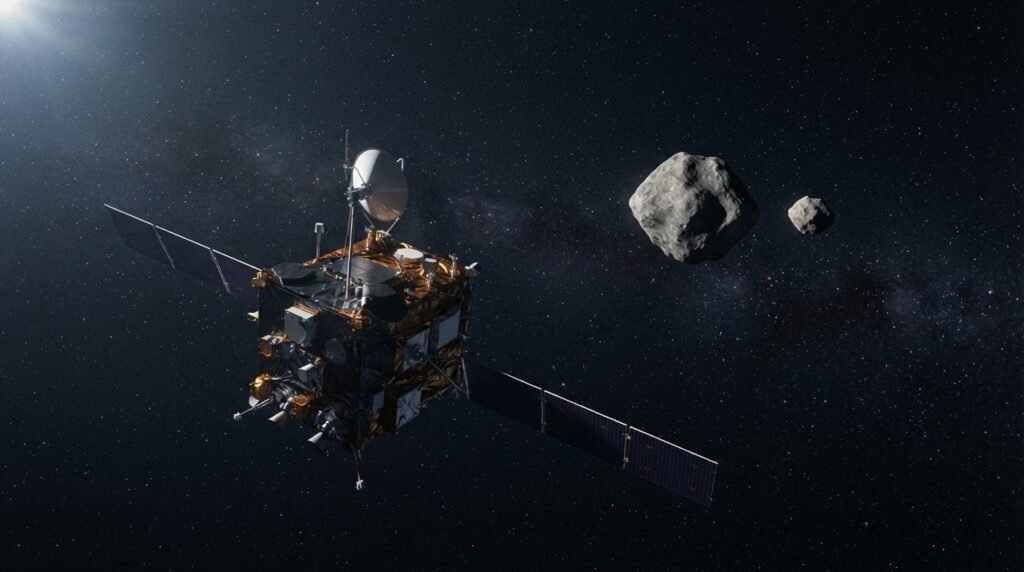
The European Space Agency’s (ESA) planetary defense mission, ‘Hera,’ has achieved its ‘first light’ observation, successfully distinguishing between the two asteroids that make up the Didymos binary system, located approximately 197 million km from Earth. This milestone marks the beginning of a comprehensive deep-space mission to verify the physical changes and impact scars resulting from humanity’s first attempt to artificially alter an asteroid’s orbit.
‘First Light’ and the Achievement of Separated Observation at 197 Million km
On October 27, 2026, the European Space Agency (ESA) officially released imaging data showing the Hera probe clearly separating the Didymos and Dimorphos binary asteroid system into distinct celestial bodies. This observation was performed on the evening of October 18 using the onboard monochrome ‘Asteroid Framing Camera.’ At the time, Hera was positioned approximately 1,280 km away from the binary pair.
Previously, data from Hera’s instruments had perceived the Didymos system only as a single point of light. However, this observation captured the satellite asteroid, Dimorphos, clearly separated from the primary asteroid, Didymos. Although Dimorphos occupied only a single pixel in the initial image, the technical significance lies in the mechanical confirmation that the two bodies are spatially distinct and no longer masked by one another.
Successful Deceleration and Physical Metrics of the Binary System
Hera’s success in separately observing the two asteroids was made possible by a series of precise orbital maneuvers and deceleration plans implemented earlier this month. The Hera operations team completed two ‘braking manoeuvres’ spaced a week apart, reducing their relative velocity to the asteroid system to approximately 20 meters per second. This allowed the spacecraft to gradually approach the asteroids along a finely tuned arrival trajectory.
The specific dimensions and motion characteristics of the Didymos binary system are as follows:
- Primary Asteroid (Didymos): With a diameter of approximately 780m, it is slightly smaller than the Burj Khalifa, the world’s tallest building.
- Satellite Asteroid (Dimorphos): With a diameter of approximately 151m, it is roughly the size of the Great Pyramid of Giza.
- Orbital and Rotational Characteristics: The two bodies orbit each other at an average distance of 1.15 km, with Dimorphos circling Didymos at a speed of approximately 18 cm per second.
Follow-up Research and In-situ Verification of the DART Impact
A core objective of this mission is to analyze the aftermath of the kinetic impact test conducted by NASA’s DART (Double Asteroid Redirection Test) mission on September 26, 2022. During that mission, the DART spacecraft struck Dimorphos at a speed of 6.1 km/s, ejecting a debris plume spanning 10,000 km and shortening Dimorphos’s orbital period by approximately 33 minutes.
However, significant scientific questions remain following this first-ever planetary defense test. It is currently unknown whether the artificial impact left only a crater on the surface of Dimorphos or if it fundamentally altered the asteroid’s overall structure. Hera’s critical mission includes determining the precise composition, internal structure, and mass of Dimorphos, as well as identifying the cause of the orbital deviation that exceeded previous impact simulation predictions.
CubeSat Deployment and Upcoming Close-Up Observations
Ian Carnelli, the Hera mission manager, stated that the images will become significantly clearer as the spacecraft moves closer to the asteroids. The ESA is scheduled to release the first high-resolution, detailed images of Dimorphos on November 25, 2026. Over the coming months, the Hera probe plans to conduct detailed, close-range investigations of the DART impact site.
This mission involves not only the Hera mothership but also two shoebox-sized CubeSats deployed from the probe. These CubeSats will approach even closer than the main spacecraft to perform multi-angle, in-situ investigations, with plans to eventually attempt a landing on the asteroid surface. Additionally, the ESA is sharing mission progress with the public through the ‘Hera Space Companion,’ an AI-based communication platform.
Official Sources and Publication Information
This article is based on an official press release published by the European Space Agency (ESA) on October 27, 2026.
- Source: European Space Agency (ESA) official announcement (October 27, 2026)
- Original Link: https://www.esa.int/Space_Safety/Hera/First_light_Hera_resolves_two_asteroids_instead_of_one