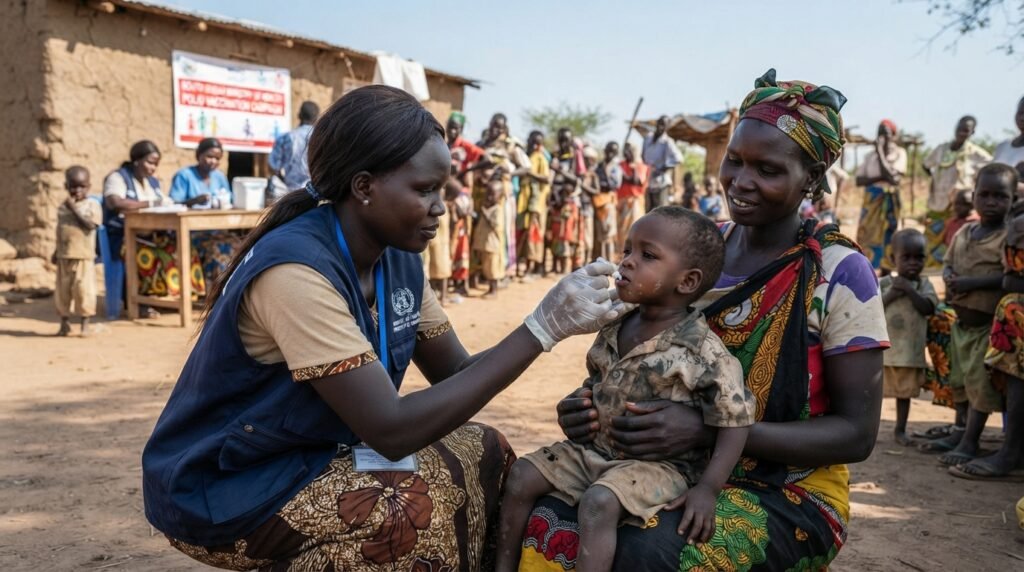
The South Sudan Ministry of Health, in collaboration with the World Health Organization (WHO), UNICEF, and partner organizations, is conducting a nationwide polio vaccination campaign targeting approximately 3.9 million children aged 0 to 59 months. This initiative is a critical public health effort aimed at breaking the transmission chains of circulating vaccine-derived poliovirus type 1 (cVDPV1) and type 2 (cVDPV2) currently circulating in South Sudan.
Concurrent Outbreaks of Type 1 and Type 2 Poliovirus
According to a press release issued by the WHO Regional Office for Africa on October 30, 2026, South Sudan is facing a concurrent outbreak of cVDPV1 and cVDPV2. As of October 19, 2026, 18 cases of cVDPV1 and 4 cases of cVDPV2 have been confirmed among reported cases of acute flaccid paralysis (AFP) across the country.
Additionally, environmental surveillance samples have detected two cVDPV1 isolates and two cVDPV2 isolates. Vaccine-derived poliovirus can emerge when weakened vaccine viruses circulate for a prolonged period in under-immunized populations, making the maintenance of high vaccination coverage essential.
First Phase Campaign Progress and County-Level Status
The nationwide first round of the vaccination campaign was originally scheduled to run from October 13 to 16, 2026, but was rolled out in a staggered manner due to operational and logistical constraints. As of October 19, 73 counties had completed the first round, while vaccinations were ongoing in 6 counties. One county, however, had not yet commenced due to accessibility challenges.
The first round reached over 3.3 million children under five, representing 84% of the initial national target of 3.8 million, with both nOPV2 and bOPV vaccines being administered.
Characteristics and Mechanisms of nOPV2 and bOPV Vaccines
This campaign utilizes a dual-vaccine approach, administering the novel oral polio vaccine type 2 (nOPV2) and the bivalent oral polio vaccine (bOPV) to combat the type 1 and type 2 variants.
nOPV2 is a new vaccine developed to address cVDPV2 outbreaks; it offers increased genetic stability compared to the traditional monovalent type 2 vaccine, thereby reducing the risk of reverting to a circulating variant. The co-administered bOPV is a live attenuated vaccine that builds active immunity against type 1 and type 3 polioviruses, inducing strong mucosal immunity in the gut to block person-to-person transmission.
Field Vaccinations and International Support
Despite challenges such as insecurity, population displacement, and hard-to-reach remote areas, vaccination teams, health workers, and volunteers have employed a door-to-door approach. On October 22, a vaccination team in green jackets visited the home of 28-year-old mother Asinti Suzan in New Site, Yei Town, to vaccinate her 7-month-old twins.
This initiative is supported by the Global Polio Eradication Initiative (GPEI) and receives financial and technical assistance from international partners, including the King Salman Humanitarian Aid and Relief Centre, Rotary International, the Mohamed bin Zayed Philanthropic Foundation, the Bill & Melinda Gates Foundation, and the European Investment Bank (EIB). Dr. Chol Makur Aciek, Undersecretary at the South Sudan Ministry of Health, urged all parents and communities to participate in the vaccination effort.
Second Round Planning and Health Authority Outlook
The South Sudanese health authorities and the WHO are continuing monitoring activities to identify unvaccinated children following the first round and are planning a second nationwide vaccination campaign for November 2026.
Dr. Moses Ongom, Acting WHO Representative for South Sudan, emphasized that with the continued commitment and efforts of the government and partners, the shared goal of eradicating polio in South Sudan is within reach.
Official Sources and Publication Information
This article is based on a press release published by the WHO Regional Office for Africa on October 30, 2026.
- Official Source: WHO Africa – South Sudan conducts nationwide polio vaccination campaign targeting 3.9 million children
- Publication Date: October 30, 2026