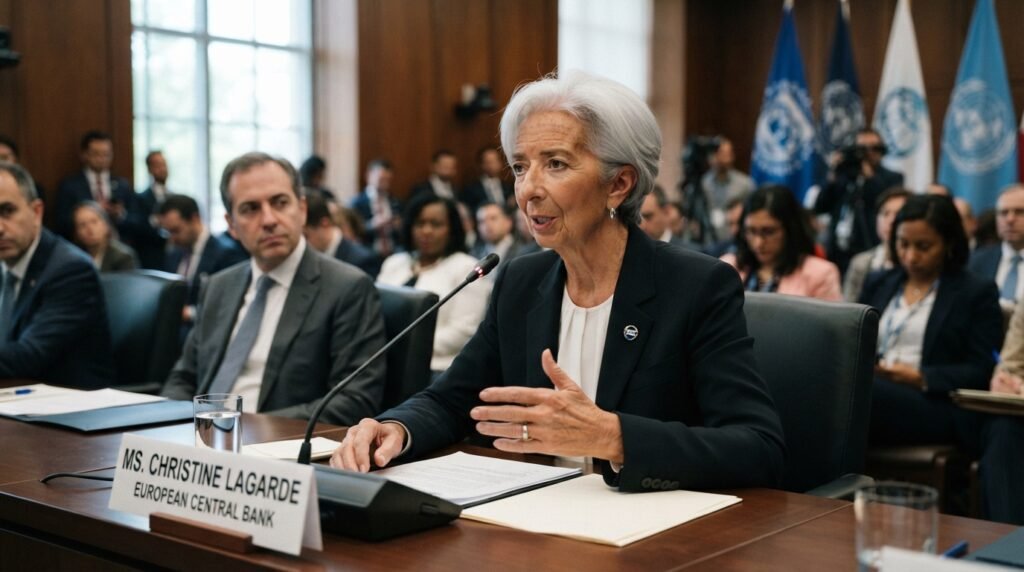
1. [Official Announcement] Eurozone Inflation Rebounds to 3.8% Amid Middle East Crisis and ECB Interest Rate Hikes
On October 17, 2026, European Central Bank (ECB) President Christine Lagarde released a formal written statement for the 54th meeting of the International Monetary and Financial Committee (IMFC), officially disclosing the Eurozone’s recent economic trends and monetary policy stance. This announcement addresses the repercussions of surging energy prices caused by the escalating geopolitical conflict in the Middle East on the European and global economies. According to President Lagarde, Eurozone headline inflation (consumer price index) rose to 3.8% in September 2026, driven by a spike in energy costs, while core inflation saw a marginal increase to 2.5%. In response, the ECB Governing Council decided to raise the key interest rate by 25 basis points (bp, 1bp=0.01%p) in June, followed by another 25bp hike in September.
2. [Performance and Economic Outlook] Eurozone Growth Estimates and Medium-Term Inflation Convergence
According to the ECB, despite geopolitical headwinds, the Eurozone economy showed relatively robust growth during the first half of 2026 across major nations and industries. Based on the September 2026 macroeconomic projections provided by ECB experts, annual real GDP growth for the Eurozone is estimated at 0.9% in 2026, 1.4% in 2027, and 1.5% in 2028. Key details are as follows:
- Growth Drivers: In the medium term, as energy shocks ease, domestic demand is expected to recover, supported by a rebound in real income and labor market stability. Furthermore, increased government spending on defense and infrastructure, alongside public and private investment in artificial intelligence (AI) and digital technologies, continues to underpin economic growth.
- Inflation Convergence Timeline: Headline inflation is expected to remain significantly above target until the first half of 2027 due to high energy prices. However, it is projected to trend downward as energy costs stabilize after Q1 2027, reaching the ECB’s medium-term target of 2.0% by the end of 2027.
- Wages and Second-Round Effects: To date, no significant second-round effects—whereby wage increases directly react to energy shocks and further stimulate inflation—have been observed.
3. [Unknown Variables and Policy Recommendations] Geopolitical Risks and Data-Dependent Policy
President Lagarde noted that the current environment is characterized by complex uncertainty, with both upside risks to inflation and downside risks to growth. Key unknown variables that will determine the future trajectory include:
- Geopolitical and Climate Shocks: The scale and duration of the Middle East conflict, the evolution of the Russia-Ukraine war, and extreme weather events linked to climate change remain potential triggers for further volatility in energy and food prices.
- Monetary Policy Criteria: The ECB recognizes that tightening financing conditions are increasing pressure for an economic slowdown. Future interest rate policy will be strictly data-dependent, evaluating incoming economic data, core inflation trends, and the strength of monetary policy transmission.
- Fiscal and Structural Reforms: The ECB recommended that governments maintain fiscal sustainability by implementing only temporary and targeted energy support measures while urging structural reforms to boost labor force participation and promote the adoption of AI technologies.
4. [Sources and Limitations] Official Data and Reference Dates
This article is based on a single primary source: the official written statement (Christine Lagarde: IMFC Statement) released by the European Central Bank (ECB) on October 17, 2026. It does not include independent verification figures from third-party institutions and strictly conveys the official content published by the ECB.
Official Source List:
- European Central Bank (ECB) President Christine Lagarde’s IMFC Statement: https://www.ecb.europa.eu/press/key/date/2026/html/ecb.sp261017~7015ea3099.en.html (Publication date: October 17, 2026)