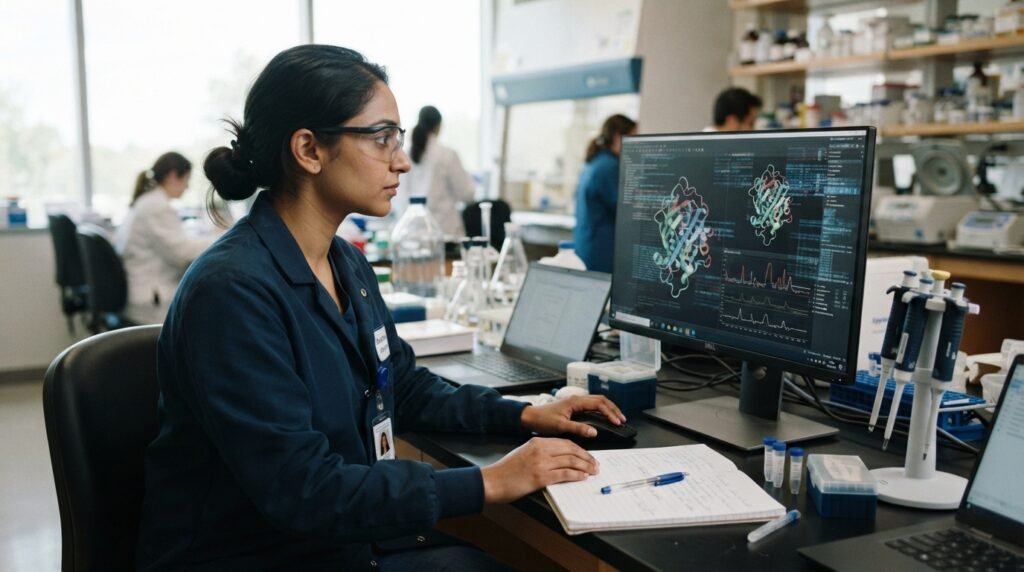
On September 30, 2026, Google DeepMind announced ‘SynthID Bio,’ an innovative watermarking technology that identifies proteins as AI-generated while perfectly preserving their unique biological functions. This development is considered a significant milestone in safeguarding biosecurity and preventing the misuse of AI in the rapidly advancing field of synthetic biology.
In recent years, the emergence of AI models such as AlphaFold has enabled humanity to freely design customized proteins for disease treatment and eco-friendly material development. However, these technological advances have a dark side: the potential for easily designing biological weapons, such as lethal toxins or novel viruses. SynthID Bio was developed by Google DeepMind to bridge this security gap.
Reliable Identification Without Compromising Biological Function
The core of SynthID Bio is the insertion of subtle ‘digital watermarks’ directly into AI-generated protein sequences or predicted 3D structures, which are undetectable to the human eye or standard analytical methods. The watermark is designed to be clearly identifiable through specialized verification tools without altering the protein’s physical or chemical properties.
According to experimental results released by Google DeepMind, watermarked protein designs showed identical performance to non-watermarked controls in laboratory environments regarding binding affinity (KD) and natural diversity. For instance, in tests involving vascular endothelial growth factor (VEGF-A) binding proteins, the watermarked version perfectly maintained its original biological activity. Furthermore, it was proven that there is almost no structural difference before and after watermark insertion in structures predicted by the protein structure prediction model, AlphaFold 3 (such as 7PPA).
A ‘Firewall’ Against Bioterrorism and Misuse
This technical announcement is expected to serve as a catalyst for redefining global biosecurity frameworks, beyond being a mere technical achievement. SynthID Bio provides a transparent layer to track the provenance of AI-designed biological materials. This helps protect the reliability of open-source scientific databases shared by academia and industry, while proactively blocking malicious actors from synthesizing and distributing dangerous proteins.
In particular, if global companies providing gene synthesis services adopt this technology, they will be able to rapidly screen whether protein sequences ordered by customers are dangerous materials manipulated by AI. This will serve as a powerful technical line of defense that practically supports international safety norms, such as the Biological Weapons Convention.
Impact and Challenges for the Global Bio-Industry
The emergence of SynthID Bio also signals major changes for global pharmaceutical and biotech companies engaged in drug development. As the safety of AI-designed proteins is verified, regulatory approval processes may become more transparent, and companies can utilize this as a means to protect the intellectual property (IP) of the synthetic proteins they develop.
However, several challenges remain for this technology to become a global standard. First, it remains to be seen whether other AI developers will voluntarily adopt this watermarking standard. Second, continuous technological advancement is required to block attempts to intentionally damage or bypass the watermark. Finally, whether global gene synthesis regulatory authorities will adopt it as a legal or institutional requirement is a point to watch in the future.
Google DeepMind announced that it plans to build an ecosystem where advanced scientific technology can safely contribute to humanity by linking the SynthID Bio technology with the safety enhancement measures of its next-generation frontier AI model, ‘Gemini 4 Argon.’