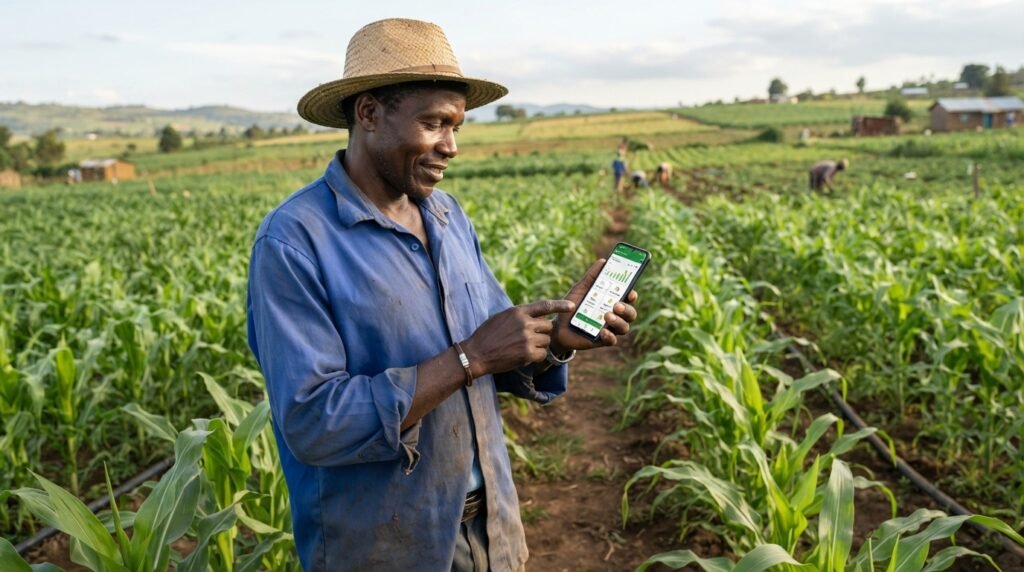
On October 26, 2026, Google’s philanthropic arm, Google.org, announced a $2.5 million investment to support the World Bank Group’s ‘AgriConnect’ initiative, aimed at building AI-powered digital public infrastructure for smallholder farmers in emerging economies. This collaboration, involving the International Finance Corporation (IFC) and the World Bank Group, aims to provide an integrated digital agricultural platform to over 1 million farmers worldwide by the end of 2027.
Google.org and World Bank Group AgriConnect Global Collaboration
Rowan Barnett, Director of Google.org for Asia Pacific, Europe, Middle East, Africa, and Global Community, officially announced the $2.5 million grant on October 26, 2026. This funding builds upon an existing global strategic partnership between Google and the World Bank Group designed to accelerate the digital transformation of emerging markets.
In this project, Google.org’s funding will be directed toward expanding the agricultural digitalization efforts of the World Bank Group and its private investment arm, the International Finance Corporation (IFC). The shared goal is to ensure that smallholder farmers in developing nations, who have traditionally been excluded from online data access and key agricultural services, can easily access essential, livelihood-linked services via a digital network.
Digital Public Infrastructure (DPI) and Open Network for Agriculture (ONA) Architecture
The core mechanism of this partnership is the massive expansion of ‘Digital Public Infrastructure (DPI)’ for the agricultural sector. DPI refers to shared digital systems that provide a foundation for connectivity, much like public roads allow online services to function seamlessly.
Previously, agricultural digital services in developing countries were fragmented into disconnected, individual apps, creating structural barriers for farmers with limited digital accessibility. To address this, the World Bank Group is building an AI-powered ‘Open Network for Agriculture (ONA),’ which unifies various public and private service providers into a single shared digital network.
Single-Platform Services and Local Language AI
Utilizing the ONA system, farmers will be able to access essential agricultural resources through a single platform without the need to install multiple complex applications. According to Google.org, key features and services supported by the ONA platform include:
- Local Language Voice AI Guidance: A feature providing advice on farming techniques, real-time weather forecasts, crop prices, and financial information via voice commands in local languages.
- Digital Farmer ID: An integrated digital identification system to verify a farm’s identity and agricultural information.
- Financial Support and Loan Linkage: Integration with local financial institutions to check credit lines and apply for credit services.
- Direct Subsidy Payments: A feature to receive agricultural subsidies from government and public institutions directly into farmers’ accounts.
- Direct Marketplace: Access to a marketplace that reduces distribution steps, allowing for the direct trading of agricultural products.
India Pilot Success and Expansion to Three Global Hubs
This initiative follows the successful operation of the ONA pilot project in India, which served as the foundation for scaling the system globally. The system’s robustness was enhanced based on the shared network model proven in the local Indian market.
The World Bank Group will significantly expand the project to multiple countries across three key regions: Latin America, Southeast Asia, and Sub-Saharan Africa. This will combine the agricultural support systems of local public institutions and private companies into a single ONA platform, providing farmers with direct access to digital public goods.
2027 Targets and Limitations of Single-Source Reporting
Google.org and the World Bank Group have set a concrete goal for 1 million farmers to be using services that improve their livelihoods by the end of 2027. Future implementation phases will focus on securing infrastructure footholds in target countries and integrating standard interfaces with local private and public service providers.
However, all information in this article is based on a single beneficiary and investment announcement released by Google.org via its official blog on October 26, 2026. Consequently, detailed implementation specifics—such as budget allocations per country, limitations due to local telecommunications infrastructure, and legal approval processes by nation—remain subject to future official disclosures from the World Bank and the IFC.