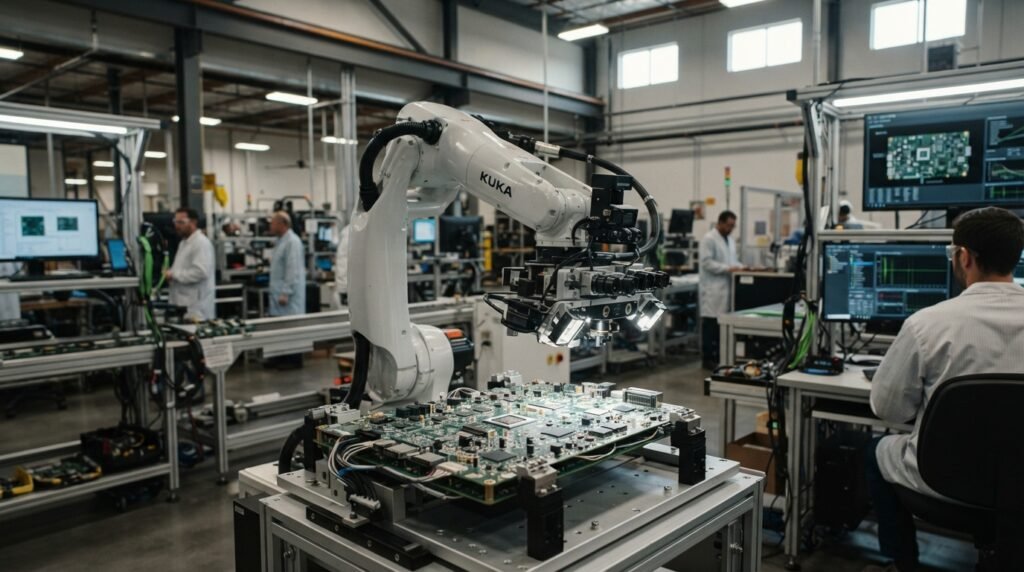
On October 21, 2026, NVIDIA announced a significant expansion of its ‘NVIDIA Cosmos’ platform, designed for the development of Physical AI and robotics systems. The update includes new training tools, simulation checkpoints, and blueprints for the Cosmos Data Factory. This expansion enables developers in autonomous driving, industrial robotics, and vision AI to process large-scale multimodal and multisensory data, drastically shortening development cycles from virtual simulation training to optimized deployment.
Cosmos Data Factory and Five Cloud-Native Blueprints
The NVIDIA Cosmos Data Factory is an integrated solution for collecting, labeling, augmenting, and evaluating the multisensory video and cognitive data required for training Physical AI. ‘Cosmos Curator,’ responsible for video data refinement, has been updated with new multimodal and multisensory input processing capabilities. Alongside this, NVIDIA is providing five core cloud-native blueprints via GitHub, Microsoft Azure, Nebius, and CoreWeave.
These blueprints are specifically designed to automate data collection and synthetic generation to support the creation of world models.
- Autonomous Vehicle Dataset Generation: Expands training scope by labeling real-world driving data and adding synthetic scenarios of rare driving conditions.
- Image Attribute Augmentation: Dynamically modifies object visual elements to increase image retrieval precision.
- Event Video Generation: Creates synthetic videos of rare or dangerous events based on static images.
- Defect Image Generation: Synthetically generates training data for inspection models targeting PCBs, metals, glass products, and more.
- Video Data Augmentation: Freely switches weather or lighting conditions while maintaining the structural integrity of the original footage.
Real-World Applications and Results in Automotive, Robotics, and Computer Vision
Global enterprises are already leveraging these Cosmos Data Factory blueprints to achieve significant efficiency gains. Porsche, part of the Volkswagen Group, utilized the Voxel51 platform and the Cosmos Data Factory within a Microsoft Azure environment to build an autonomous driving data flywheel shared across all group brands. This is projected to reduce the need for repetitive physical road testing by up to 90% and shorten overall development cycle times by up to 85%.
Industrial inspection robot manufacturer ANYbotics used the Cosmos blueprints to generate over 1,500 synthetic video clips, verifying the output with the Encord platform. Using this data, ANYbotics trained its robots to precisely detect liquid leaks and subtle changes in equipment during facility inspections. Furthermore, computer vision company Ultralytics retrained its flagship YOLO object detection model by combining synthetic target defect data created with Cosmos with real-world imagery, significantly improving defect localization and recall performance.
Cosmos Framework Expansion and Open Model Retraining Mechanisms
NVIDIA has expanded the ‘Cosmos Framework’ into an open-source model-compatible development tool to apply refined datasets to actual robot and AI model architectures. Developers and AI agents can utilize fine-tuning and reinforcement learning to enhance Hugging Face-compatible open models, including GR00T, Alpamayo, QWEN, and Pi0.5. Knowledge distillation and quantization techniques are employed during the model optimization process.
Robotics research lab MicroAGI successfully post-trained the ‘Cosmos 3’ model using human object-manipulation video data to develop world models for autonomous task execution. They successfully compressed a 32-billion parameter inference model into an 8-billion parameter ‘Nano’ model without losing accuracy. Developers can label and train Cosmos 3 for specific environments on the Roboflow platform and deploy it immediately to hosting environments or their own NVIDIA GPU infrastructure.
Simulation-Specific Nano Models and Real-Time Vision Monitoring Performance
NVIDIA introduced a new ‘Cosmos 3 Nano’ model variant that allows developers to validate autonomous driving and robot control policies within virtual simulation environments. This enables the infinite creation of complex, difficult-to-replicate scenarios based on multi-view and multisensory data. Consequently, control policies for bimanual robots and autonomous driving software can be safely tested and evaluated in closed-loop simulations before physical deployment.
In operational phases, the revamped NVIDIA Cosmos 3 NIM (NVIDIA Inference Microservice) is utilized. It improves inference speeds by up to 2x compared to previous systems without compromising model quality, providing real-time risk alerts in sub-second timeframes. Additionally, the ‘NVIDIA Metropolis Blueprint VSS 3.3’ for video search and summarization increases the number of video streams that can be monitored with the same GPU resources by 40%. The Abu Dhabi National Oil Company (ADNOC) is currently using this blueprint in combination with Fogsphere’s MistIQ platform to detect safety risks across 65 sites in real time, while integrating the Cosmos Data Factory to generate training data for rare hazard scenarios.
Technical Limitations and Future Challenges
While the virtual data-driven world model training offered by the NVIDIA Cosmos platform significantly reduces the costs of physical testing, it faces the challenge of perfectly bridging the ‘Sim-to-Real gap’ between virtual simulations and the real world. Furthermore, as Cosmos NIM microservices are deployed into complex industrial environments with diverse sensor specifications, continuous assessment of computational maintenance costs and inference accuracy will be essential through future industrial pilot deployments.