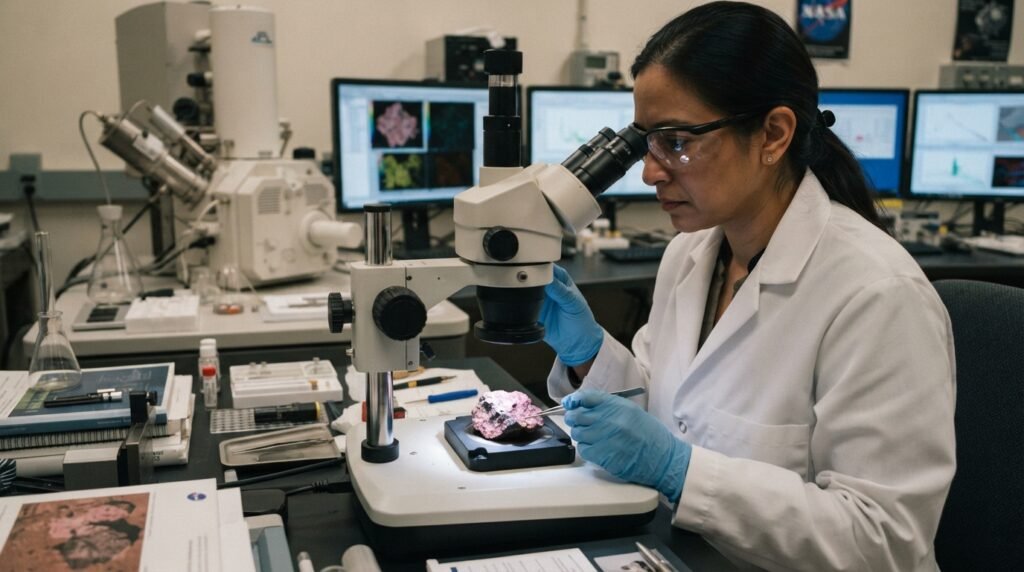
Researchers supported by NASA have confirmed through precision analysis that the meteorite ‘Teghaza 001,’ discovered in the Sahara Desert in 2022, is an ancient Martian rock formed more than 4.1 billion years ago. This pinkish, approximately 800g (2-pound) rock is considered one of the oldest samples among the roughly 435 Martian meteorites discovered on Earth. The findings were published in the journal ‘Science.’
4.1 Billion-Year-Old Martian Rock ‘Teghaza 001’ Found in the Sahara
Named after the salt flats of Teghaza, Mali, where it was discovered, ‘Teghaza 001’ had an unknown age and origin upon its initial discovery. However, a research team led by Dr. Yang Liu of NASA’s Jet Propulsion Laboratory (JPL) determined that it is a fragment of the Martian crust that crystallized more than 4.1 billion years ago. One of the peer reviewers compared the meteorite to a ‘Rosetta Stone’ that could unlock the secrets of Mars.
Furthermore, a separate study published in the journal ‘Science Advances’ in June 2026 addressed the water content of Teghaza 001, shedding light on the role of water in shaping the early Martian surface.
The Unique Characteristics of Teghaza 001 Among the Oldest Martian Meteorites
Teghaza 001 is one of the three oldest Martian meteorites discovered on Earth. The existing ancient meteorite ‘ALH84001’ consists almost entirely of a single mineral and has an age similar to that of Teghaza 001. In contrast, the meteorite known as ‘Black Beauty’ is a collection of small volcanic rock fragments formed approximately 2.1 billion years ago.
Unlike these, Teghaza 001 contains a complex mixture of various volcanic minerals formed as magma cooled. This sample is distinct in that it preserves the history of the early Martian crust, which was metamorphosed through interaction with groundwater following magma crystallization.
In-situ Rubidium-Strontium Dating and Zircon Crystal Analysis
Early in the research, a team from the University of New Mexico used oxygen isotope analysis to confirm the rock’s Martian origin and suggested it might be a shergottite, the most common type. However, detailed analysis revealed unique textures and rare minerals not previously reported.
A research team led by Professor Francois Tissot of the California Institute of Technology (Caltech) applied ‘in-situ rubidium-strontium (Rb-Sr) dating.’ Unlike traditional methods that dissolve the entire sample, they analyzed only single mineral grains on the surface of the rock, smaller than a fingernail, thereby preserving the precious meteorite sample. The researchers analyzed zircon crystals within Teghaza 001, proving that groundwater metamorphosis occurred approximately 4.1 billion years ago; this suggests the parent rock formed even earlier and that a dynamic hydrological cycle existed on early Mars.
Correlation with Martian Southern Highlands and 13 Candidate Source Sites
The mineral composition and chemical characteristics of Teghaza 001 match data observed by NASA’s Mars Reconnaissance Orbiter (MRO) in the cratered highlands of the southern hemisphere of Mars. Based on orbital observation data, researchers identified 13 candidate sites on the Martian surface that match the characteristics of Teghaza 001.
Co-author Lee Saper, a scientist at NASA Ames Research Center, explained that this rock is the first sample in human possession to come from a part of the Martian crust that had never been studied before.
Uncovering Early Martian Hydrological Environments and Atmospheric Loss
Martian meteorites share a common history of being ejected from the Martian surface by the impact of small celestial bodies, drifting through space, and eventually landing on Earth. Scientists verify the Martian origin of meteorites by comparing them with data collected by landers like Viking, Curiosity, and Perseverance rovers.
The traces of water-rock interaction remaining in Teghaza 001 document the state of the ancient atmosphere and hydrosphere during the period when Mars was losing its water. The micro-particle dating technology validated in this study is expected to be useful for dating other Martian meteorites as well as future lunar and asteroid return samples.
Official Source: NASA-funded Study Details One of Oldest Mars Meteorites Ever Found