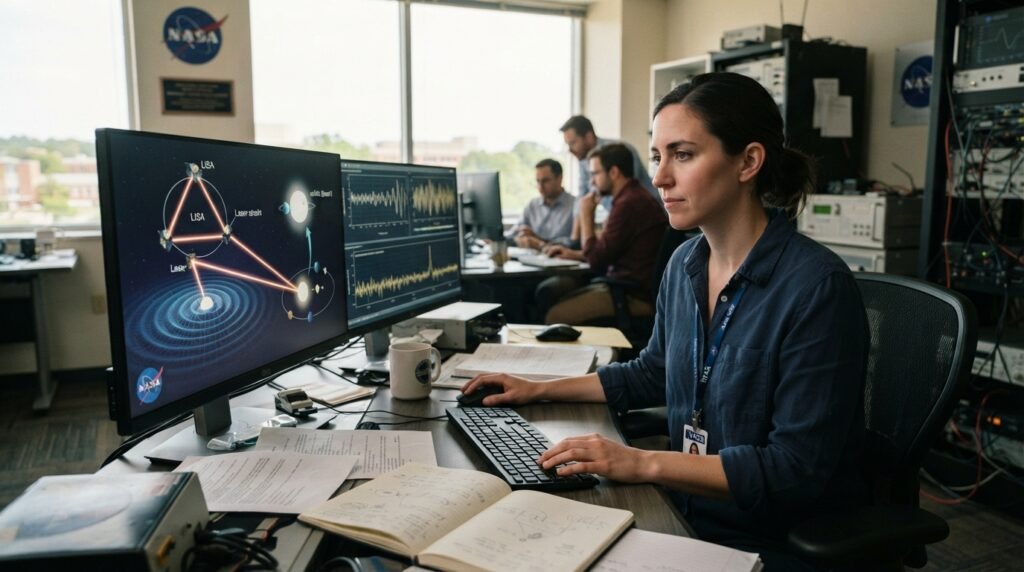
Researchers from NASA and the University of Maryland, Baltimore County (UMBC), in collaboration with the European Space Agency (ESA), have detailed a mechanism to detect exoplanets orbiting white dwarf binary systems throughout our galaxy using the upcoming Laser Interferometer Space Antenna (LISA) mission. The findings were published in two papers in The Astrophysical Journal.
LISA and the Mechanism for Gravitational Wave-Based Exoplanet Discovery
According to the research findings released on November 10, 2026, the first paper—authored by Dr. Casey McGrath, a postdoctoral researcher at UMBC and NASA’s Goddard Space Flight Center—analyzes the detection methodology and the ranges for planetary mass and orbital periods. The second paper, co-authored by Dr. McGrath and colleagues, outlines a verification strategy using the James Webb Space Telescope (JWST). The concept of searching for exoplanets around white dwarf binary systems was first proposed by Japanese astronomer Naoki Seto in 2008.
The primary observation targets are double white dwarf systems, where two Earth-sized stellar remnants orbit each other in less than an hour. The gravity exerted by an orbiting planet causes a tiny reflex motion in the host star system. Similar to the radial velocity method used in traditional light-based astronomy, this motion imprints periodic changes onto the emitted gravitational wave signals.
Doppler Modulation Analysis and Galactic Targets
Scott Noble, a theoretical astrophysicist at NASA Goddard, explained that double white dwarf systems emit gravitational waves at nearly constant frequencies. If a sufficiently massive planet is present, the reflex motion causes Doppler modulation in the gravitational wave signal.
Dr. Casey McGrath likens this phenomenon to modern radio communication. Just as sideband signals containing audio or music data form on either side of the main carrier frequency during radio transmission, this method identifies exoplanets by interpreting secondary signals (sidebands) that appear above and below the main frequency of the gravitational waves.
The quantitative data and primary targets for the LISA mission within the galaxy include:
- Estimated total double white dwarf systems with periods under one hour in the Milky Way: Approximately 10 million
- Systems to be individually resolved and observed by LISA: Approximately 10,000
- Mixed binary systems including neutron stars or black holes: Approximately 100
Cross-Verification with the James Webb Space Telescope
To ensure that gravitational wave-detected exoplanets are not false positives, the researchers have established a verification procedure that incorporates infrared observations from the James Webb Space Telescope (JWST). Mary Anne Limbach of the University of Michigan stated that this joint observation confirms that gravitational wave signals are indeed caused by actual planets.
If an exoplanet exists in a white dwarf binary system, it emits an infrared excess in the spectrum that would not be present with the stars alone. According to the team’s simulations, JWST can detect exoplanets with approximately five times the mass of Jupiter in white dwarf binary systems 500 light-years away. Furthermore, under ideal conditions, the LISA mission alone may be able to detect gravitational wave sideband signals from sub-Jupiter-sized planets.
ESA/NASA Mission Structure and Mid-2030s Launch Plan
The LISA mission is a major space exploration project led by the ESA with NASA as a partner, targeting a launch in the mid-2030s. The mission consists of three spacecraft traveling in a triangular formation, following Earth in its orbit around the Sun, with each side of the triangle measuring 1.6 million miles (about 2.5 million km).
Equipped with two telescopes, each spacecraft will transmit and receive infrared laser beams to measure minute distance changes between them with precision finer than the diameter of a helium atom. NASA provides the precision laser system, the charge management device for the test masses, gravitational wave signal analysis algorithms, and technical support for science and engineering.
Official Source: NASA Scientists Show How Gravitational Waves Can Reveal New Worlds