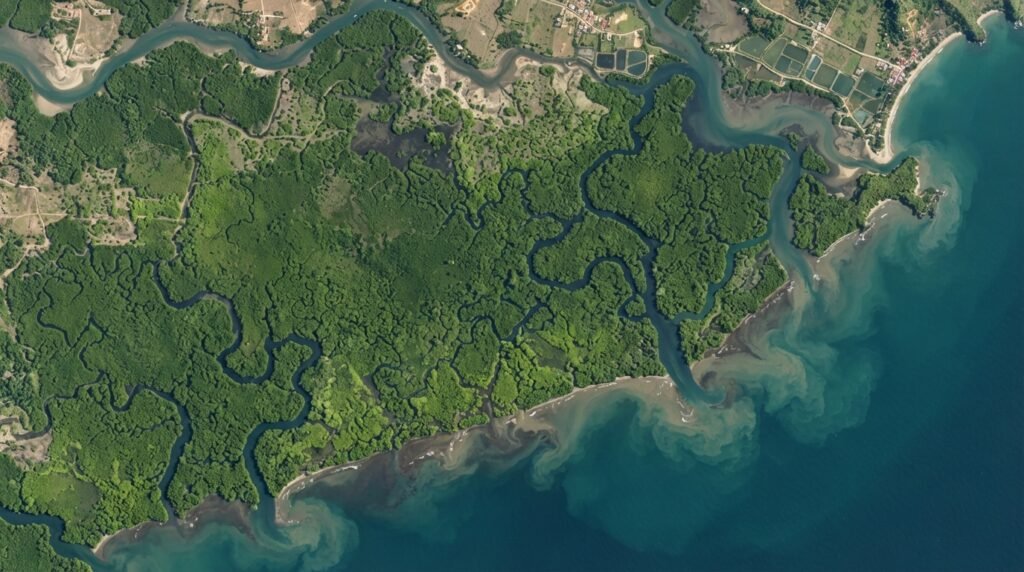
According to satellite data analysis released by NASA’s Earth Observatory on November 13, 2026, the total global area of mangrove forests, which had been in decline for decades, began to rebound in 2010 and has since recorded a continuous recovery trend. Research published in the journal ‘Science’ indicates that analysis of Landsat satellite imagery from 1984 to 2023 shows that while approximately 3,000 square kilometers (1,200 square miles) of mangrove forest were lost globally between 1984 and 2010, the area has increased by about 2,000 square kilometers (770 square miles) since 2010.
The Mangrove Rebound Evidenced by 1984–2023 Satellite Data
A research team led by Dr. Zhen Zhang, an environmental scientist at Tulane University, analyzed Landsat satellite images from 1984 to 2023 to examine changes in mangrove area and canopy density. The researchers found that approximately two-thirds of the global mangrove expansion is due to colonizing new areas, while the remaining third is attributed to the restoration and regrowth of damaged regions. Furthermore, they explained that many of today’s mangrove forests show denser, more robust canopies compared to 2010, indicating healthier forests with less degradation, particularly in regions such as South America.
A Reversal in Southeast Asia and Myanmar and Strengthened Legal Protections
A notable reversal within the global recovery trend occurred in Southeast Asia, particularly in Myanmar (Burma). In the 1980s and 1990s, Myanmar experienced a rapid decline in mangrove forests due to the expansion of coastal agricultural land, aquaculture, and firewood harvesting, losing 28.6 percent of its total mangrove area between the 1980s and 2010. However, the trend reversed after 2010, with Myanmar’s mangrove area growing by approximately 10 percent.
According to comparison images released by NASA’s Earth Observatory using Landsat 5 (captured February 14, 2010) and Landsat 9 (captured February 2, 2026), the expansion of mangrove forests was captured in the Palaw township area of the Myeik district in Myanmar. In this region, regeneration is taking place on abandoned rice fields south of the village of Kyauktaung, and residents of nearby Pyin Bukyi island have been experimenting with conservation projects and tree-planting efforts. The authors attribute this turnaround to increased awareness and restoration efforts following the 2004 Indian Ocean tsunami, strengthened legal protections for forests, and high sedimentation rates that have opened up new mudflats.
Habitat Expansion Driven by Sedimentation and Rising Temperatures
In various regions, including the Amazon River estuary and northern Australia, extensive sediment deposition has formed new mudflats where mangroves have successfully established themselves, contributing to steady growth since the 1990s. Dr. Zhang also explained that at the northern and southern limits of mangrove distribution, including the southeastern United States, rising temperatures and fewer freezing events have allowed mangroves to expand into areas that were previously too cold for them to survive.
Carbon Sink Value, Regional Disparities, and Remaining Challenges
Although mangrove trees are relatively small with an average height of about 13 meters (43 feet), mangrove ecosystems can store up to four times more carbon than tall inland tropical rainforests. They also protect coastal communities from erosion and storm surges, and their distinctive prop roots provide vital habitats and nurseries for fish, shrimp, and crabs.
However, recovery is not universal. In West and Central Africa, the total mangrove area has decreased since 2010 due to significant losses in the Niger Delta, while in North America and Southern Africa, large mangrove zones have suffered severe degradation due to tropical cyclones.
Dr. Zhang warns that the global success observed over the past decade should not be a cause for complacency, noting that slowing deforestation and protecting existing forests, when combined with natural expansion and regeneration, can lead to immense positive impacts.
Official Source List:
– NASA Earth Observatory: https://science.nasa.gov/earth/earth-observatory/a-global-rebound-for-mangroves/