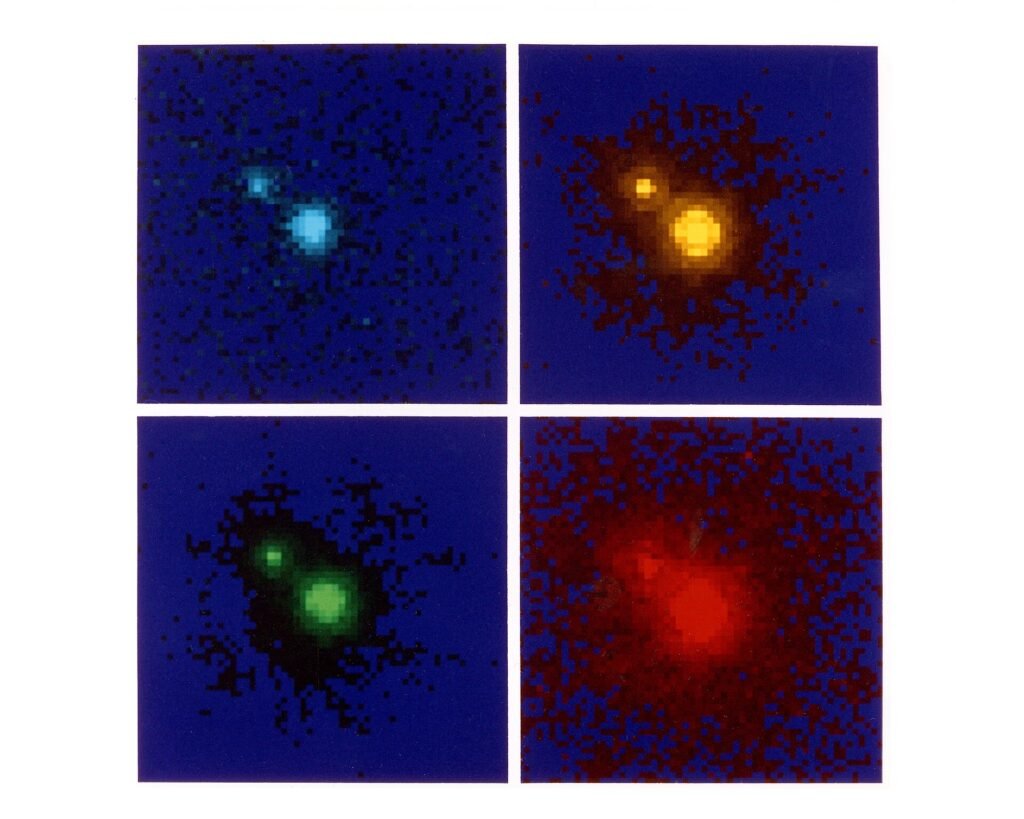
Professor John Bahcall, Dr. Donald Schneider, Dr. Dan Mayoz, all of the Institute for Advanced Study · PUBLIC DOMAIN · Wikimedia Commons · Source
On November 12, 2026, the mission team for NASA’s Hubble Space Telescope officially released a gallery of diverse strong gravitational lenses that will serve as follow-up targets for the next-generation Nancy Grace Roman Space Telescope. The coordinated observations between the Roman telescope—which launched in August 2026—and the Hubble telescope are expected to contribute significantly to uncovering the secrets of galaxy evolution and dark matter.
November 12, 2026: Hubble Reveals Targets and Synergy with the Roman Telescope
NASA’s Goddard Space Flight Center Hubble mission team has completed a diverse collection of celestial objects by using the Hubble Space Telescope to conduct high-resolution observations of strong gravitational lens candidates first identified by the Dark Energy Spectroscopic Instrument (DESI) at the Kitt Peak National Observatory. Gravitational lensing is a physical phenomenon first predicted by Albert Einstein, where the gravity of a massive foreground galaxy or galaxy cluster bends and magnifies the light from a distant background galaxy, creating an effect similar to placing a giant lens in space.
Astronomers are building lens models based on observational data of precisely aligned background and foreground galaxies, which are used to determine the mass distribution of the foreground galaxy. The high-resolution data obtained by Hubble lays the foundation for the Roman Space Telescope to scan and analyze large-scale samples of gravitational lenses in the future.
The Gravitational Lensing Mechanism and Testing Cold Dark Matter Theory
By precisely analyzing the degree of distortion in background galaxies caused by gravitational lensing, researchers can quantitatively calculate the invisible dark matter mass and spatial distribution of foreground galaxies. The sharpness and high resolution of the Hubble telescope allow it to detect even minute structural defects within gravitational lens arcs, serving as a direct tool for tracking the existence of invisible, small-scale dark matter clumps.
The research team hopes this will enable them to test the “Cold Dark Matter” theory, a core model of cosmology. The Cold Dark Matter theory predicts the existence of numerous small-scale dark matter clumps in the universe, ranging from one million to one billion times the mass of the Sun. Compared to the total dark matter halo mass of our Milky Way—approximately 1.3 trillion solar masses—these are very small structures, and their existence will be determined through precise analysis of Hubble imagery.
Characteristics of Key Celestial Objects: Arcs, Einstein Rings, and Quadruple Lenses
The gravitational lens gallery released by NASA showcases diverse geometric lens structures depending on the arrangement and shape of the foreground and background galaxies.
- Panel A (Arc-counter-arc structure): The gravity of two merged foreground galaxies bent the light of a background galaxy to form a duplicated pair of arcs.
- Panel F (Einstein Ring): The foreground spherical lens mass and the background galaxy are perfectly aligned in a straight line, creating an Einstein Ring structure where the background galaxy image almost perfectly encircles the foreground galaxy.
- Panel I and C (Quadruple lens structure): In Panel I, light from a background galaxy appears duplicated in the form of four dots around the foreground galaxy. Panel C also exhibits a quadruple lens structure and captures two node regions within the background galaxy where star formation is active.
- Panel D (Dust lane blockage): A rare dust lane exists in the center of the foreground galaxy in this gravitational lens system, causing the Einstein Ring image to appear visually broken.
Leveraging Wavelengths and Field-of-View for Inter-Mission Synergy and AI Tools
The Hubble and Roman telescopes share a complementary relationship in terms of observational wavelength ranges and fields of view. Hubble is specialized for high-resolution, narrow-field observations in visible, ultraviolet, and some infrared wavelengths. Conversely, the Roman telescope observes mainly in the infrared and some visible light, utilizing a much wider field of view to capture panoramic cosmic images.
For instance, in the case of the Einstein Ring in Panel D, which appears broken due to a dust lane in visible light, follow-up observations by the Roman telescope, with its superior infrared transmission capabilities, can determine if it is a truly perfect ring structure. Additionally, by studying Hubble’s high-resolution gravitational lens images in detail, researchers are pre-building super-intelligence analysis tools that can efficiently search for similar arc structures in the large-scale imagery that the Roman telescope will collect.
Multidisciplinary Telescope Collaboration and Future Galaxy Evolution Research
The color differences in gravitational lens arcs provide key information for determining the evolutionary characteristics of early universe galaxies. Blue arcs represent ultraviolet light emitted by young stars, while red arcs indicate regions of galaxies composed of relatively older stars. While most galaxies acting as foreground lenses are elliptical, the gallery includes galaxies with spiral arms like those in Panels B and F, or elongated shapes like those in Panel G, allowing for the comparison and verification of various galaxy evolution pathways.
These observational results represent a prime example of the collaborative network of NASA’s Great Observatories, which includes Hubble, the Chandra X-ray Observatory, the James Webb Space Telescope, and the next-generation Roman Space Telescope. The plan is to continue advancing cosmology and galaxy evolution research through a complementary system where the Roman telescope discovers interesting gravitational lens targets with its wide field of view, followed by high-resolution visible and ultraviolet observations from Hubble.
Official Source and Related Announcement:
– NASA Goddard Space Flight Center, “NASA’s Hubble Offers Cosmic Sampler of Targets for Roman” (Announced November 12, 2026): https://science.nasa.gov/missions/hubble/nasas-hubble-offers-cosmic-sampler-of-targets-for-roman/