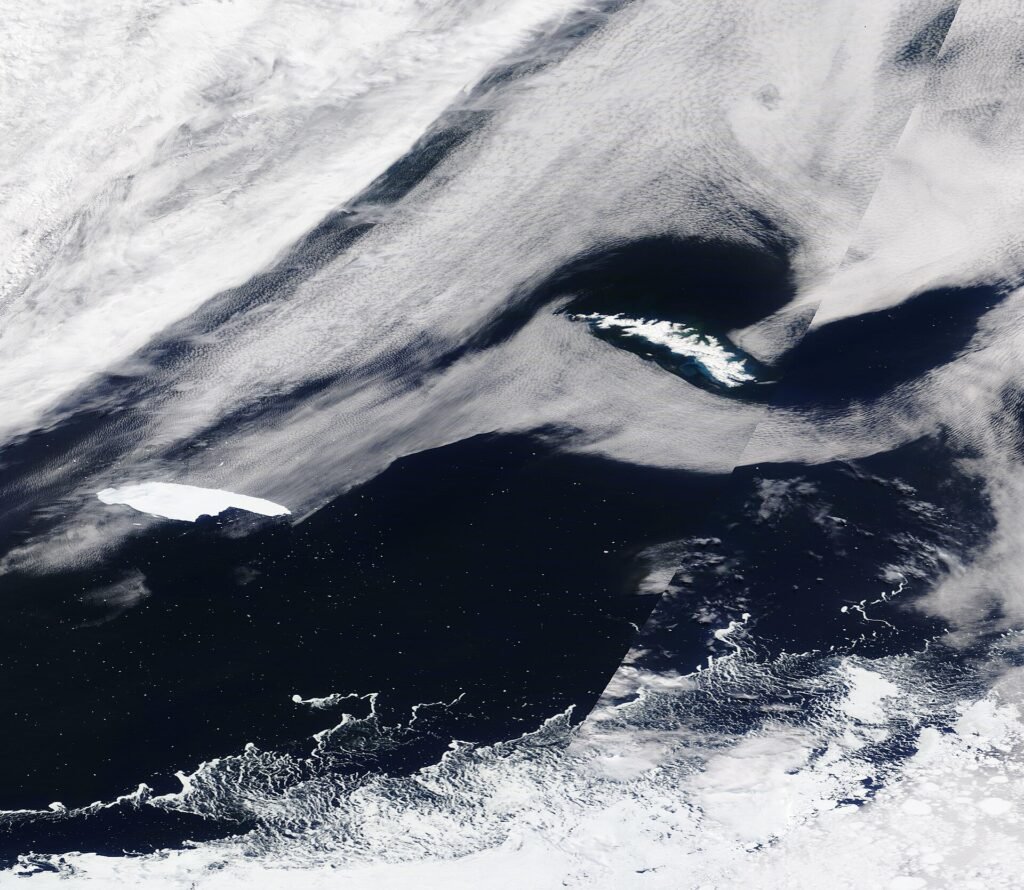
MODIS Land Rapid Response Team, NASA GSFC · PUBLIC DOMAIN · Wikimedia Commons · Source
On October 27, 2026, the NASA Earth Observatory announced that ‘A-81,’ a massive iceberg measuring 1,550 square kilometers that broke off from Antarctica’s Brunt Ice Shelf, has reached the edge of the underwater continental shelf near South Georgia island after drifting for three years. The trajectory data collected by Earth-observing satellites serves as a scientific case study, confirming in real-time the dynamic characteristics of high-latitude drifting icebergs as they significantly slow down due to friction with shallow seafloor topography.
MODIS Observations from the Terra Satellite and Signs of A-81 Grounding
According to a satellite imagery analysis report released by the NASA Earth Observatory on October 27, 2026, the Moderate Resolution Imaging Spectroradiometer (MODIS) aboard NASA’s Terra satellite captured precise images of iceberg A-81 as it passed near South Georgia in the South Atlantic on October 20, 2026. At the time of observation, the A-81 iceberg showed a noticeable decrease in movement speed as it made contact with the shallow underwater shelf edge southwest of the island.
Based on data analysis by Dr. Jan Lieser of the Australian Bureau of Meteorology and Dr. Christopher Shuman, a retired researcher from the University of Maryland, the A-81 iceberg exhibited behavior of “bumping along the edge,” slowly moving while colliding with vertical seafloor strata along the boundary where the shelf becomes shallower. NASA clarified that this report is based on actual observational facts derived from satellite data provided by the Earth Observatory, the sole official source.
Brunt Ice Shelf Fractures and the Three-Year Trajectory of A-81
Iceberg A-81 is a large ice mass covering approximately 1,550 square kilometers (about 600 square miles). It fully separated in January 2023 when ‘Chasm 1,’ a major rift in the Antarctic Brunt Ice Shelf, fractured. While the Chasm 1 rift had remained relatively stable for about 35 years, it began expanding again in 2012, with the rate of breakage accelerating rapidly after 2019.
Following its separation, the A-81 iceberg remained within the Weddell Sea for over three years, following the ‘Weddell Gyre,’ which circulates clockwise along the Antarctic coast. It reached the northernmost tip of the Antarctic Peninsula in May 2026 before heading north into the Scotia Sea. By late October 2026, it had entered the waters off South Georgia, approximately 2,300 kilometers (1,400 miles) north-northwest of its origin point at the Brunt Ice Shelf.
Topographic Features of the South Georgia Continental Shelf and Historical Iceberg Paths
The waters surrounding South Georgia have served as a primary gateway where large icebergs moving north from the Antarctic continent often stall or run aground due to shallow shelf topography. In fact, there is a precedent: in 2025, the super-iceberg ‘A-23A’ grounded on the same South Georgia continental shelf before fragmenting into pieces.
NASA researchers stated that while A-81 has entered a stalling phase due to friction with the seafloor—similar to the past experience with A-23A—it remains an open question whether the iceberg will fully ground or eventually move along the outer edge of the shelf via ocean currents, requiring continued satellite tracking.
The Continuous Disintegration of the Brunt Ice Shelf and the Role of Polar Observation Networks
The Antarctic Brunt Ice Shelf has been a focal point for the polar meteorological community, as it has consecutively shed massive icebergs in recent years. The Brunt Ice Shelf, home to the British Antarctic Survey (BAS) Halley Research Station which has been in operation since the 1950s, has seen several icebergs break off in addition to A-81.
- 2021 Separation: Iceberg A-74 broke off from the ‘North Rift’ and subsequently fragmented.
- January 2023 Separation: The acceleration of ‘Chasm 1’ led to the birth of the 1,550 km² A-81 iceberg.
- 2024 Separation: Iceberg A-83 broke off from the ‘Halloween Crack’ and is currently following A-81 northward.
Currently, several icebergs, including A-83, have exited the Weddell Sea and are moving north along the path of A-81. NASA plans to continue monitoring the drift trajectories and deceleration of these iceberg clusters through its Earth-observing satellite network.
Official Sources and Limitations of Data
The content of this article is based on the satellite observation report ‘A-81 Reaches South Georgia,’ officially published by the NASA Earth Observatory on October 27, 2026. The official primary data confirmed for this matter is limited to the single satellite observation report from NASA. This article excludes speculative claims regarding ecosystems or water quality not explicitly stated in the satellite observation data and addresses only verified scientific observational metrics.
Official Source List:
- NASA Earth Observatory (Published October 27, 2026): https://science.nasa.gov/earth/earth-observatory/a-81-reaches-south-georgia/