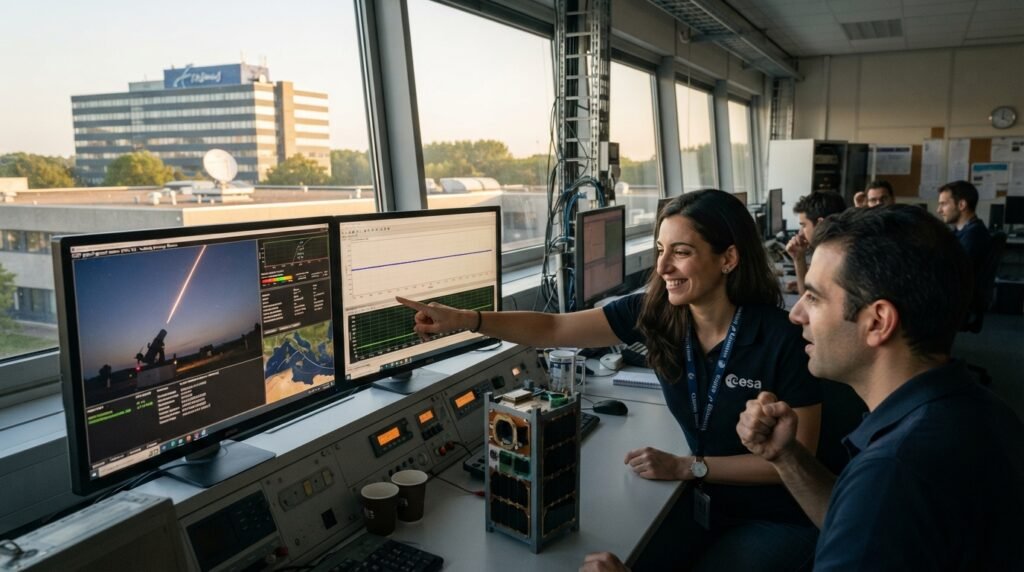
The ‘ERMIS-3’ 8U CubeSat, jointly developed by the European Space Agency (ESA) and researchers at the National and Kapodistrian University of Athens (NKUA), has successfully established a laser optical communication link with a terrestrial optical ground station. This achievement marks the first successful optical link from a Low Earth Orbit (LEO) satellite in Greece and sets a significant milestone in validating optical communication technology based on small satellite platforms.
November 2, 2026 Announcement and ERMIS-3 Mission Overview
In an official announcement on November 2, 2026, the European Space Agency (ESA) reported that the ‘ERMIS-3’ 8U CubeSat, developed by researchers at the National and Kapodistrian University of Athens (NKUA), successfully established a laser link with an optical ground station just weeks after completing its commissioning phase. ERMIS-3 was launched on March 30, 2026, alongside its sister satellites, ERMIS-1 and ERMIS-2, as part of the Greek National Space Programme, implemented by ESA on behalf of the Greek government.
The mission aims to validate optical communication technology in orbit for CubeSats. While optical links can facilitate the transmission of large volumes of data generated in applications like Earth observation, they present technical challenges: the satellite must accurately point, acquire, and track (PAT) a narrow laser beam while moving at several kilometers per second, all while contending with atmospheric conditions.
Holomondas Ground Station Integration and ‘ATLAS-1’ Optical Terminal Mechanism
The ERMIS-3 satellite is equipped with the ‘ATLAS-1’ optical communication terminal, developed for small satellites by the Lithuanian company Astrolight. The satellite successfully linked with the receiving terminal installed at the ‘Holomondas Optical Ground Station (HolOGS-1),’ operated by researchers at the Aristotle University of Thessaloniki (AUTh) in Greece.
Unlike conventional radio frequency communication, optical communication uses a narrow laser beam to transmit data. As a LEO satellite travels at high speeds, both terminals must acquire the signal and maintain continuous tracking. Atmospheric conditions, such as cloud cover, add complexity by potentially blocking the link or degrading signal quality due to turbulence.
ESA’s Technical Verification Support and Atmospheric Constraints
ESA provided technical support for the success of the ERMIS-3 optical link through environmental testing and precision optical alignment at the ESA European Space Research and Technology Centre (ESTEC) in Noordwijk, the Netherlands.
Optical communication links are subject to complex atmospheric conditions, where clouds can completely block the link and turbulence can degrade signal quality. Despite these environmental constraints, the research team successfully established the link with the ground station.
Transmission of Large-Scale Earth Observation Data and Institutional Evaluation
In-orbit optical communication technology using small satellites can help transmit the massive amounts of data generated by Earth observation missions, such as high-resolution and hyperspectral imaging, back to Earth.
Frederic Rouesnel, Head of the Connectivity and Secure Communications Department at ESA, remarked, “This achievement demonstrates that through close cooperation between industry, academia, and institutions, Europe can achieve world-class innovation.” ERMIS Principal Investigators, Professors Vaios Lappas and Antonis Paschalis, explained, “By using ATLAS-1 as our laser communication terminal, we have achieved the first operation of a laser optical link from a CubeSat, opening new capabilities and opportunities for secure communications for small satellites within the European ecosystem.”
Greek Space Technology Milestones and Future Outlook
Professor Kleomenis Tsiganis of the Aristotle University of Thessaloniki, who oversees the Holomondas ground station and Space Situational Awareness (SSA) activities, emphasized, “This success is the first optical link ever established with a LEO satellite in Greece—specifically from Holomondas—and is of particular importance as it was achieved with a Greek space asset, ERMIS.”
Official Announcement Source: ESA Official Press Release (Published November 2, 2026)