Image: NASA · PUBLIC DOMAIN · Wikimedia Commons · Source
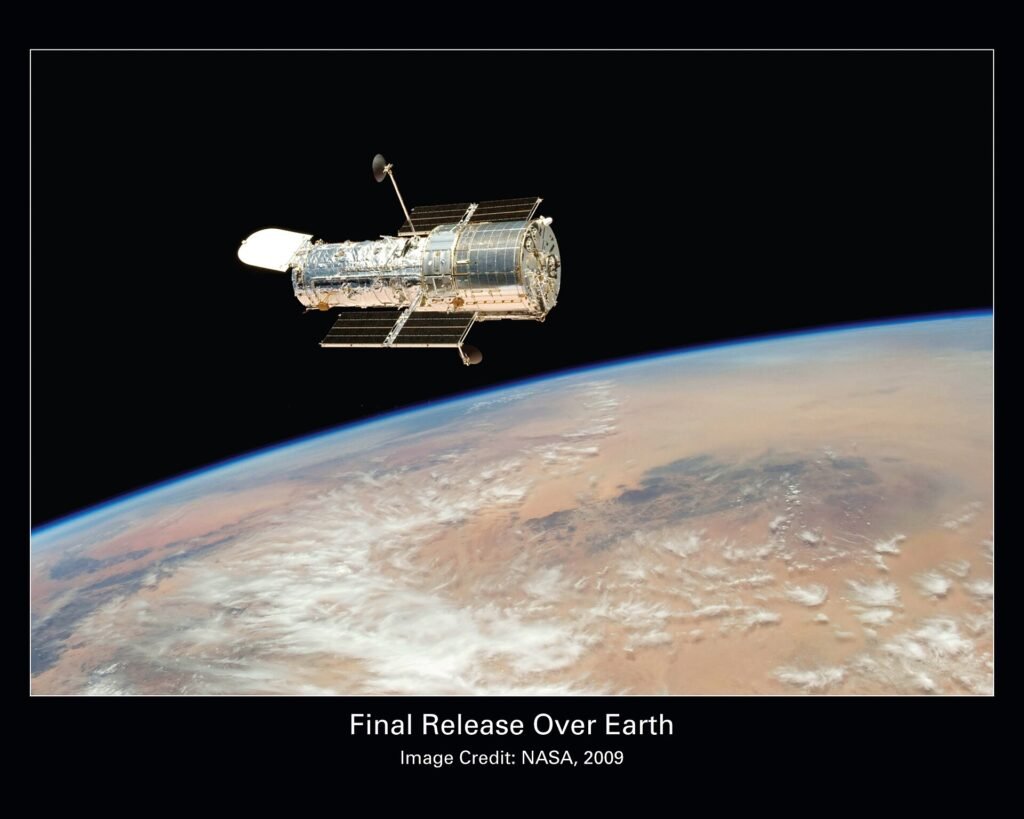
NASA has announced the issuance of an official Request for Information (RFI) to evaluate the technical capabilities of private space companies for the on-orbit servicing and life extension of the Hubble Space Telescope, which is currently operating in low-Earth orbit. The initiative aims to continue generating breakthroughs in space science by artificially raising the telescope’s orbital altitude or incorporating commercial servicing capabilities for an asset that has fundamentally transformed humanity’s view of the universe for over 35 years.
NASA Officially Issues RFI for Hubble Life Extension and Orbital Servicing
The RFI released by NASA is designed to assess whether the on-orbit satellite capture and servicing technologies currently held or under development by the commercial space industry can be applied to the Hubble Space Telescope.
Jared Isaacman, a NASA Administrator, stated, “Hubble remains a productive scientific mission with significant science to still perform, and we must look at all reasonable opportunities to keep the telescope operating as long as possible. If there are innovative, cost-effective ways to extend the life of existing assets, we have a responsibility to our taxpayers and the scientific community to explore them,” he added, noting that “extending the life of Hubble means more discoveries, more science, and more opportunities to expand our understanding of the universe.”
Lack of Onboard Propulsion and Atmospheric Drag: Predicted Re-entry Between 2033–2034
Like all spacecraft in low-Earth orbit (LEO), the Hubble Space Telescope is experiencing a slow decrease in orbital altitude due to atmospheric drag, which is the subtle resistance of the atmosphere. Hubble is not equipped with an onboard propulsion system to maintain its own orbit.
According to projections from the NASA orbital analysis team, without external intervention or altitude-boosting measures, the Hubble Space Telescope is expected to naturally re-enter the Earth’s atmosphere between 2033 and 2034. Consequently, NASA estimates that a mission to ensure the telescope’s safety and extend its operational life would need to be executed no later than 2032.
Three Key Areas for Commercial Space Servicing Missions
NASA’s RFI seeks to explore participation from the commercial space industry across three core technical challenges:
- Re-boosting Mission: Technology to use commercial spacecraft to lift the Hubble telescope to a higher orbit, directly extending its scientific observation life.
- On-orbit Servicing and Capability Enhancement: Technology to service the Hubble telescope in orbit to upgrade key observational capabilities and operational functions.
- Safe Controlled Re-entry and Disposal: Technology to safely guide the telescope for a controlled re-entry into the Earth’s atmosphere or to move it to a designated disposal orbit at the end of its operational life.
Rapid Growth in Commercial Servicing and Integration with Next-Generation Missions
Dr. Nicky Fox, Associate Administrator for the Science Mission Directorate at NASA Headquarters, emphasized that Hubble is a national icon that has fundamentally changed humanity’s view of the universe for more than 35 years. Dr. Fox noted that private space companies are rapidly advancing new technical capabilities in the field of satellite capture and on-orbit servicing.
She stated, “Given the time remaining before Hubble’s predicted atmospheric re-entry, we are eager to quickly explore all possibilities to boost Hubble to a higher orbit while we develop next-generation flagship missions to succeed it.”
35-Year Operations, Institutional Roles, and Submission Schedule
Launched in 1990, the Hubble Space Telescope has been in operation for over 30 years, shaping humanity’s fundamental understanding of the cosmos. Hubble is operated as an international collaborative project between NASA and the European Space Agency (ESA).
NASA’s Goddard Space Flight Center in Greenbelt, Maryland, manages the overall telescope and mission operations, while Lockheed Martin Space, based in Denver, Colorado, supports the flight operations at Goddard. Additionally, the Space Telescope Science Institute (STScI) in Baltimore, Maryland, is contracted by the Association of Universities for Research in Astronomy (AURA) to oversee Hubble’s science observation operations.
Responses to this RFI can be submitted online, and the deadline for document submission is Monday, November 30, at 3:00 p.m. EST.
Official Source: NASA Explores Potential Commercial Servicing for Hubble Telescope