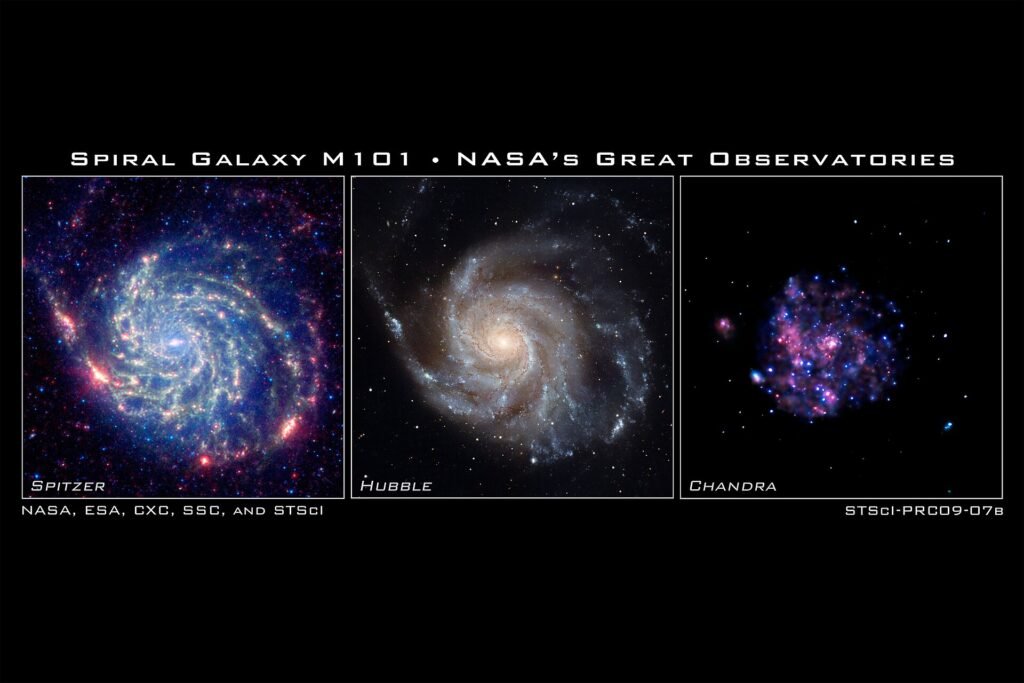
Credit for Spitzer Image: NASA, Jet Propulsion Lab/Caltech and K. Gordon (STScI) Credit for Hubble Image: NASA, ESA, K. Kuntz (JHU), F. Bresolin (University of Hawaii), J. Trauger (Jet Propulsion Lab), J. Mould (NOAO), Y.-H. Chu (University of Illinois, Urbana) and STScI Credit for Chandra Image: NASA, CXC and K. Kuntz (JHU) · CC BY 4.0 · Wikimedia Commons · Source · License
On November 9, 2026, researchers at NASA announced that data from the Chandra X-ray Observatory has identified the cause of the 113-day periodic outbursts of the massive unstable star ‘AT 2016blu’, located 30 million light-years away: a hidden companion object orbiting and stripping away material. This discovery marks the first time a 113-day periodic outburst in a Luminous Blue Variable (LBV) has been captured in the X-ray spectrum, providing an astronomical milestone in understanding mass-transfer mechanisms within extreme binary systems and the formation of Ultra-Luminous X-ray sources (ULX).
The Observation History and Mystery of the 113-Day Eruptions
Located in the spiral galaxy NGC 4559, approximately 30 million light-years from Earth, AT 2016blu is a massive Luminous Blue Variable with at least 33 times the mass of the Sun. Due to its immense mass and high energy output, it exhibits fluid brightness variations, placing it in a category of extreme stars similar to Eta Carinae.
Between 2012 and 2026, astronomers observed more than 27 rapid optical outbursts from AT 2016blu, occurring at intervals of approximately 113 days. These outbursts are so intense—due to the massive release of energy—that they have been mistaken for supernova explosions, where a star is completely destroyed. However, because the star survives and repeats these eruptions roughly three times a year, it has been classified as a ‘supernova impostor’.
Chandra X-ray Observatory’s Precision Capture and 100-Fold Brightness Increase
An international research team led by Dr. Mojgan Aghakhanloo of the University of Virginia hypothesized that the optical flashes were caused by surrounding gas clouds being heated by periodic high-energy X-ray emissions. Because another bright X-ray source exists near AT 2016blu, the high angular resolution of the Chandra Observatory was essential to clearly separate the two objects and obtain precise X-ray data.
The team detected signs of an outburst in early 2026 based on optical monitoring by the Katzman Automatic Imaging Telescope (KAIT), Las Cumbres Observatory, and approximately 30 amateur astronomers from the American Association of Variable Star Observers (AAVSO). Consequently, NASA activated its Target of Opportunity program to conduct detailed X-ray observations with Chandra in March 2026.
The results showed that during the March 2026 outburst, the X-ray brightness of AT 2016blu had increased by at least 100 times compared to observations from 2001 and 2002, before the first outburst was recorded. This serves as the first observational data demonstrating that periodic optical flashes are directly linked to powerful X-ray radiation.
Observational Metrics of Elliptical Orbit Mass Transfer and Emission Mechanisms
In a paper published in ‘The Astrophysical Journal’, the researchers explained that AT 2016blu and its compact companion are orbiting each other in an elliptical path. Each time the two objects reach periastron—the point where they are closest in their orbit—the companion’s intense gravity triggers a mechanism that strongly pulls material from the outer layers of the massive star.
In this process, the captured material spirals around the companion at near-light speeds, and this superheated material emits intense X-rays. These high-energy X-rays heat the dense gas clouds surrounding the star, creating the 113-day periodic outburst that we observe in the optical spectrum.
- System Location: Located in the outer regions of the spiral galaxy NGC 4559, about 30 million light-years from Earth.
- Primary Star Physical Data: A Luminous Blue Variable (LBV) with at least 33 times the mass of the Sun.
- Outburst Cycle: Occurs every 113 days (over 27 recorded optical flashes between 2012 and 2026).
- X-ray Emission Variation: X-ray brightness during the March 2026 outburst was over 100 times higher than the baseline in 2001–2002.
- Companion Identification: Likely a stellar-mass black hole or neutron star.
Expansion into ULX and Supernova Progenitor Research
This achievement marks the AT 2016blu system as a strong candidate for an Ultra-Luminous X-ray source (ULX). ULXs are rare, extremely bright X-ray-emitting objects in the universe; while they were previously explained by the inherent emission structures of neutron stars or black holes, this study proves a direct correlation with stellar eruptive activity.
Co-authors Dr. Núria Torres-Albà of the University of Virginia and Dr. Nathan Smith of the University of Arizona suggested that the periodic change patterns observed in stars just before a supernova might also stem from such binary interactions with compact objects. This observational model could be a key tool in explaining the complex variable behavior seen before a massive star reaches its end.
Future Challenges in Identifying the Companion
Despite this announcement, precisely identifying whether the hidden companion is a stellar-mass black hole or a neutron star remains a challenge. The research team plans to track the companion’s mass limits and precise orbital characteristics by coordinating the Chandra Observatory and telescopes across various wavelengths during future recurring periastron outbursts.
Managed by NASA’s Marshall Space Flight Center with scientific operations overseen by the Smithsonian Astrophysical Observatory (SAO), the Chandra X-ray Observatory has once again demonstrated its irreplaceable precision in the field of extreme stellar evolution research through this Target of Opportunity observation.
Official Source:
NASA Chandra Official Announcement: https://science.nasa.gov/missions/chandra/nasas-chandra-finds-source-of-stars-mysterious-outbursts/ (Published Nov 09, 2026)