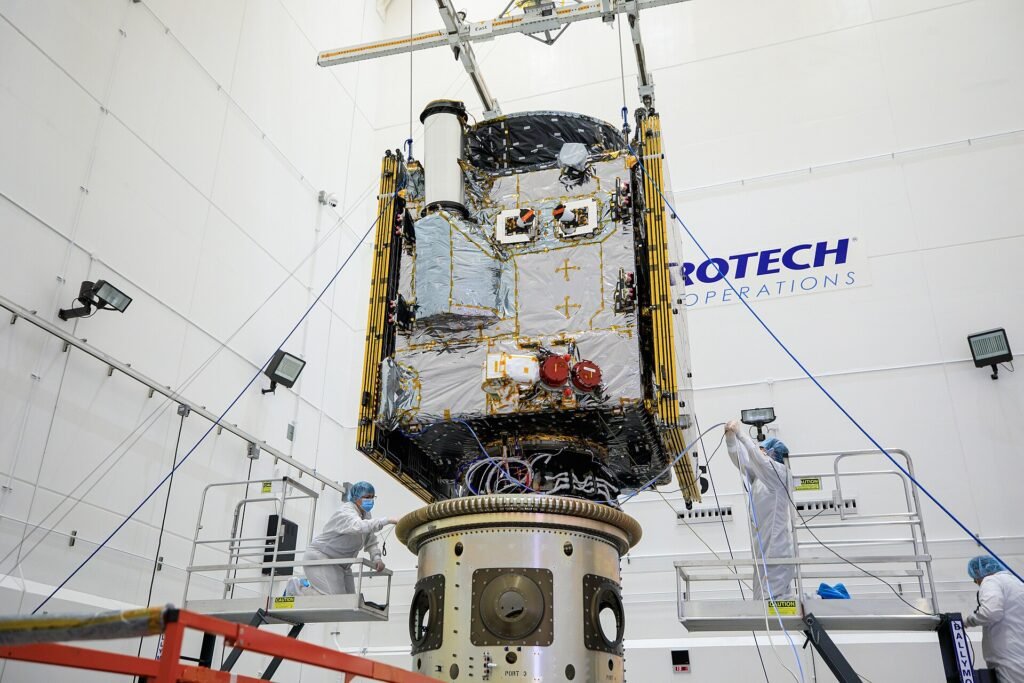
NASA Kennedy Space Center / NASA/Kim Shiflett · PUBLIC DOMAIN · Wikimedia Commons · Source
NASA’s Science Mission Directorate (SMD) has officially announced the ‘Faster to Science’ initiative and a new competition model, ‘CM 2.0 (Competition Model 2.0),’ designed to overhaul the solicitation and selection process for space exploration and scientific research missions. This reform focuses on significantly reducing the burden of complex engineering and budget estimation in initial proposals, prioritizing scientific utility to shorten the mission selection timeline by up to 45%.
Prioritizing Scientific Value and Reducing Initial Proposals by 50%
According to a letter released on October 21, 2026 (local time) by Dr. Nicola Fox, Associate Administrator of NASA’s Science Mission Directorate, this measure was promoted under the mandate of NASA Administrator Jared Isaacman. The traditional two-step mission solicitation process has long been a burden on researchers, with years required for mission concepts to reach final approval, exacerbated by uncertainties in contract management and exorbitant proposal preparation costs.
The core of the newly introduced ‘CM 2.0’ system is to ‘compete on the science first.’ In the proposal stage, the focus shifts away from complex engineering execution plans or cost estimates toward evaluating core scientific value and feasibility. NASA plans to significantly streamline Phase 1 submission documents, reducing the required proposal length by approximately 50%, thereby allowing researchers to focus on pure scientific inquiry rather than administrative procedures.
Tiered Reforms by Mission Scale and Goal of Accelerated Timelines
NASA will differentiate the solicitation process based on the scale and nature of scientific missions. Large flagship missions will maintain the ‘Large Mission Study’ framework established post-James Webb Space Telescope, with management responsibilities assigned to specific NASA centers and science teams and instruments selected through dedicated solicitations.
New, expedited procedures will be applied in stages to medium-to-large and small-scale missions. The reform plans and expected outcomes for each category are as follows:
- Astroprobe, New Frontiers, and Discovery Missions: Only three core elements are required in Phase 1: scientific justification, a science implementation plan, and a proof-of-concept mission design. The timeline from Announcement of Opportunity (AO) to Phase 2 selection will be shortened by up to 45%, from 35 months to approximately 19.5 months.
- Medium Explorer (MIDEX) and Earth Explorer: A similar two-step approach will be adopted, but the pool of implementing institutions will be expanded to include universities and private industry. Evaluations will focus on past performance in similar projects, reducing the selection period by up to 45%.
- Small Explorer (SMEX) and Missions of Opportunity: Transitioning to a single-step competition model, reducing the size of review teams, and conducting virtual site visits. This will cut the final selection time from 32 months to 19 months, a reduction of approximately 40%.
Implementation Structure Centered on Goddard and JPL
Under the CM 2.0 system, Phase 2 implementation studies will be conducted in collaboration with NASA’s two premier science centers: Goddard Space Flight Center or the Jet Propulsion Laboratory (JPL). For New Frontiers or Discovery missions, the Johns Hopkins University Applied Physics Laboratory (JHU/APL) may conduct implementation studies under the management of the Goddard Center.
During this process, the pre-Phase A and Phase A stages will be linked to identify scientific and technical implementation risks early. Down-selection to a single mission occurs during Phase A, and teams not selected will be relieved of the burden of continuing concept studies independently during the remainder of the Phase A period.
Integrating Private Space Technology and Strict Budget/Schedule Discipline
NASA has presented four key principles for operating the new system. First, the latest capabilities of the private space industry, such as commercial satellite buses, subsystems, and multi-mission operations, will be actively integrated across all mission types. As long as technical and cost advantages exist, no mission, regardless of size or complexity, will be excluded from leveraging commercial technology.
Second, by prioritizing scientific excellence, NASA will ensure fair participation opportunities for researchers and Principal Investigators (PIs) who do not have the backing of large universities or major corporations. Third, cost and schedule management will be significantly tightened. Mission complexity will be adjusted based on Phase A estimates, and strict sanctions, including mission cancellation, will apply if thresholds are exceeded. Finally, unnecessary competition between NASA centers will be reduced to foster collaboration and prevent the waste of taxpayer funds.
Global Town Hall for the Scientific Community on the 26th
NASA is preparing an online town hall meeting to directly explain the details of the ‘CM 2.0’ competition model to researchers and gather feedback. The event, hosted by NASA Headquarters, will be held on October 26, 2026, from 2:00 PM to 3:00 PM Eastern Time.
NASA science leadership, including Dr. Nicola Fox, is scheduled to attend the town hall. Academia, industry professionals, the media, and the general public can participate in real-time via a provided online link and will be able to ask questions and vote on the new mission solicitation process through a Q&A system.
Source: NASA Science Directorate Official Announcement (Published: Oct 21, 2026)