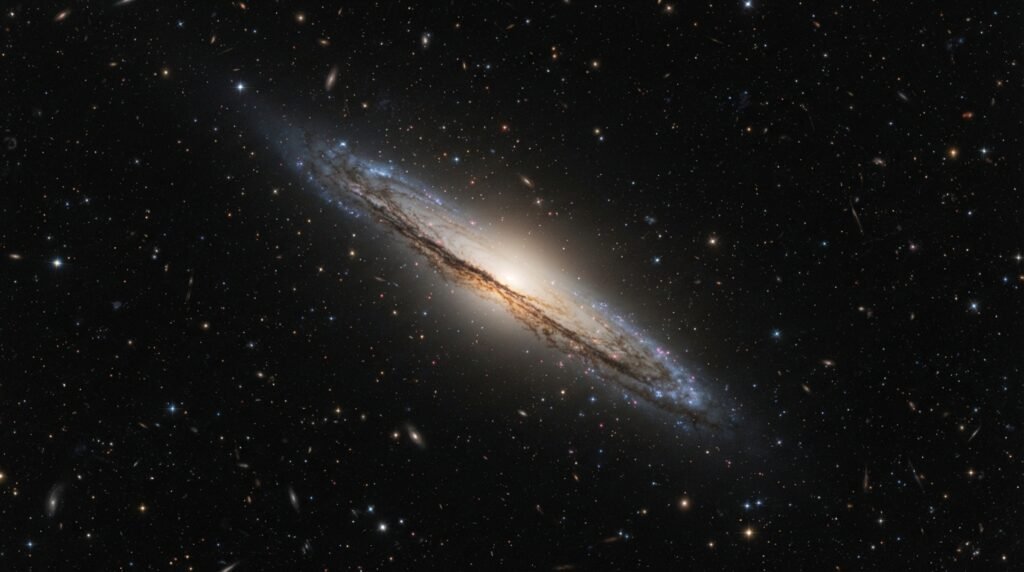
Hubble’s Edge-On View of NGC 1827
On October 16, 2026, NASA released a high-resolution edge-on image of the intermediate spiral galaxy ‘NGC 1827,’ captured by the Hubble Space Telescope. Located approximately 37 million light-years away in the constellation Columba, the galaxy displays a distinctive structure with a reddish-brown dust lane slicing horizontally across the entire galactic disk.
This image was taken using Hubble’s Advanced Camera for Surveys (ACS). The bright blue regions observed along the galactic disk are regions where NASA says new stars are likely forming. To the left of the bright central bulge, a foreground star with four diffraction spikes was captured; this star is located between Earth and NGC 1827, rather than within the galaxy itself.
Part of a Detailed Survey of 260 Satellite Galaxies
According to NASA’s Goddard Space Flight Center, the observation of NGC 1827 was conducted as part of a large-scale Hubble survey program investigating 260 satellite galaxies around 22 Milky Way-like host galaxies within about 32 million light-years of Earth.
Researchers have completed observations of 111 out of the 260 target satellite galaxies to date. NASA explained that it plans to dedicate a total of 149 additional Hubble orbits—one per galaxy—to complete the observations of the remaining satellite galaxies.
Studying Small Galaxies to Refine Cosmological Models
Low-mass galaxies serve as critical tools for verifying the predictions of cosmological models on small scales. Existing cosmological theories have struggled with discrepancies where small-scale structures do not align with actual observational data.
NASA researchers anticipate that the precise observational data collected by the Hubble Space Telescope will contribute significantly to more accurately defining the characteristics of low-mass galaxies in systems similar to the Milky Way and refining modern cosmological models.
Official Sources and Data Limitations
This report is based on a single source: the official announcement released by NASA and the Goddard Space Flight Center on October 16, 2026. Independent verification from additional institutions is not included.
The original announcement and observational images can be found at the link below.